
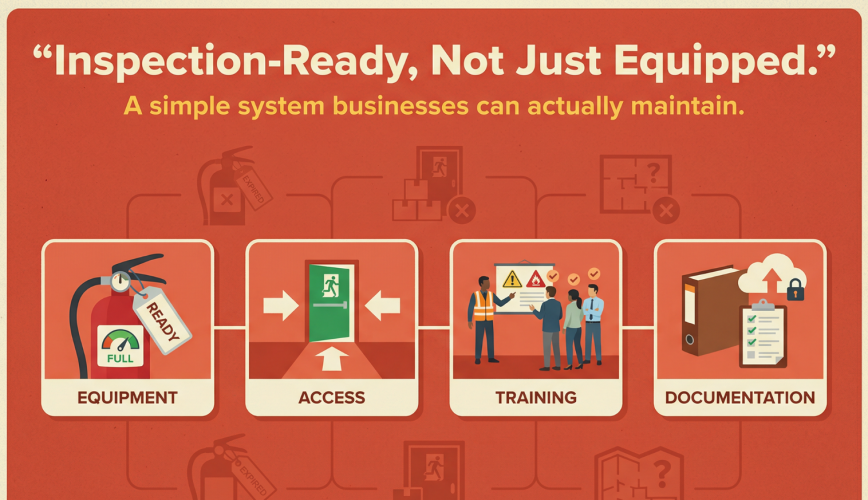
If you run a restaurant, manage properties, operate an office, or oversee a warehouse in New York City, Brooklyn, the outer boroughs, Long Island, or New Jersey, compliance is less about “checking a box” and more about staying ready all year. This guide to Fire Safety Compliance for Businesses is built to be practical: what to maintain, what inspectors commonly flag, and how to keep clean records without chaos. For local inspections, tagging, and documentation support, start here: https://anjfire.com/
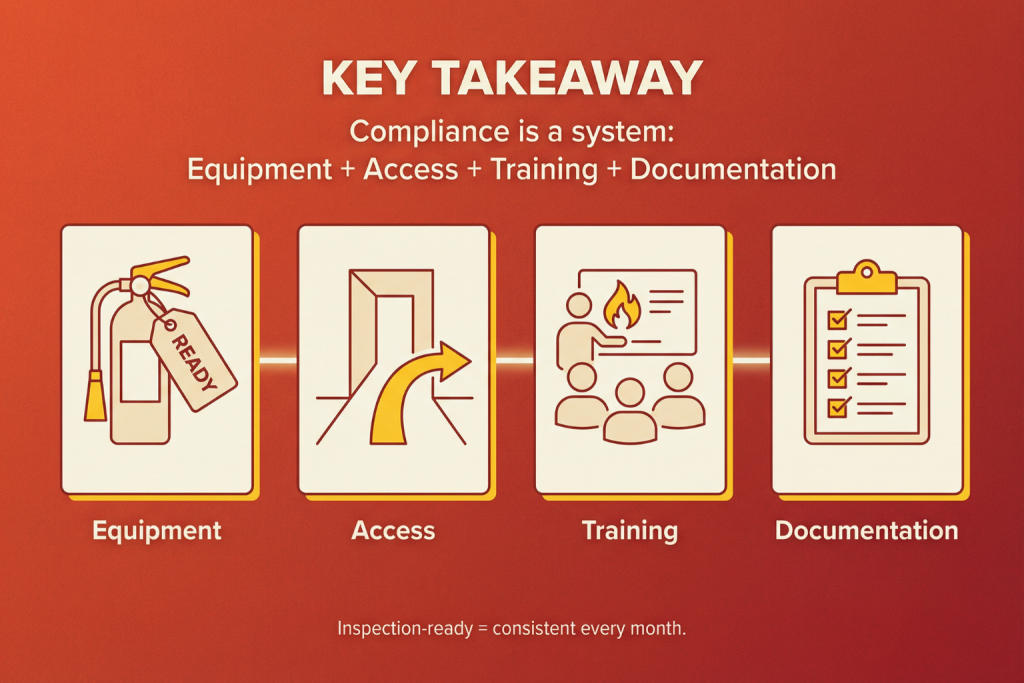
Key Takeaway
- Compliance is a system: equipment + access + training + documentation must stay consistent.
- Portable extinguishers can be extremely effective when present and working: a NAFED dataset cited in NFPA materials reports 95% success (12,505 of 13,221 incidents). NFPA Doc Info Files
- OSHA requires an annual maintenance check and a record of that maintenance to be kept (per the standard’s retention rules). OSHA
- Most failures are predictable (expired tags, blocked egress, missing plans, weak training).
- If you can’t prove it, it didn’t happen: records are part of staying inspection-ready. OSHA
Core fire-safety requirements every business should cover
Fire extinguishers: correct type, correct location, ready to use
You need the right extinguisher types for your hazards (kitchens, electrical rooms, flammables) and they must be accessible and maintained. For multi-site businesses, the simplest way to standardize is to centralize service under one plan (commercial support here): https://anjfire.com/commercial-fire-extinguisher/
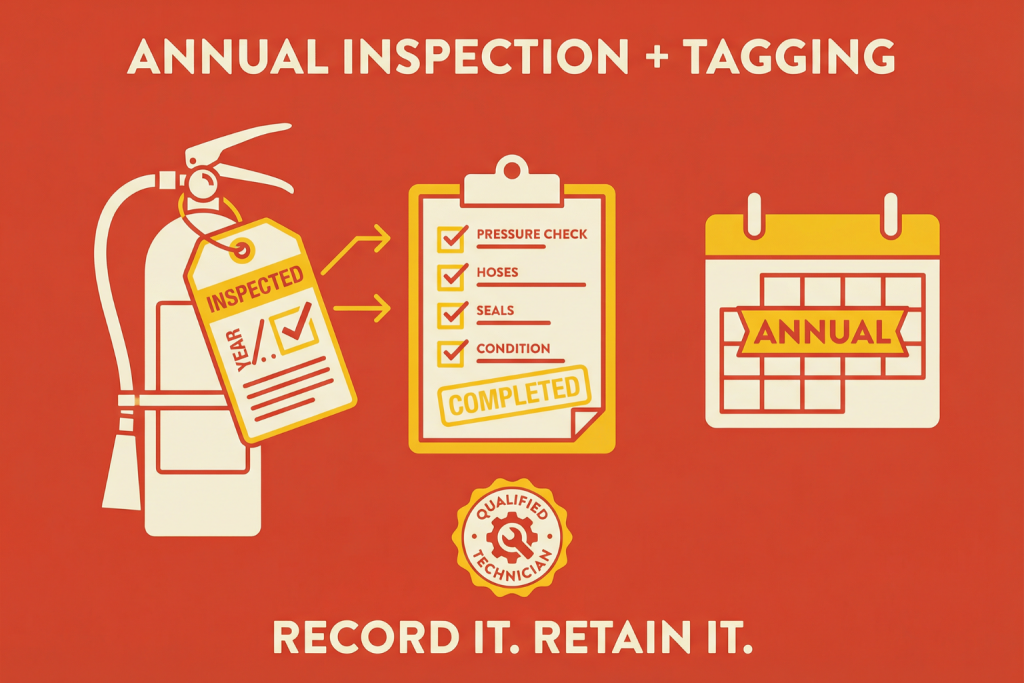
Annual inspections and tagging by qualified technicians
OSHA’s portable extinguisher standard requires employers to ensure extinguishers are subjected to an annual maintenance check, and to record/retain that maintenance record per the rule. OSHA
Clear access to exits, extinguishers, and emergency equipment
This is one of the most common “slow drift” problems deliveries and storage creep into paths, and then it becomes normal. In an emergency, access delays are deadly.
Systems as required: smoke alarms, fire alarms, sprinklers
Your building type and local code determine what systems are required. In NYC, the Fire Code applies broadly to persons and places in the city and establishes fire-safety requirements for buildings and businesses. New York City Government+1
Employee training, evacuation planning, and drills
Training can be short and still effective – what matters is that roles are clear and refreshed. Use your internal resource for extinguisher basics (PASS method):
https://anjfire.com/how-to-use-a-fire-extinguisher-properly-your-complete-pass-method-guide/
Accurate records of inspections, maintenance, and training
A clean binder (and a digital backup) prevents panic during inspections and reduces repeat violations.
Table 1: Compliance Coverage Map (fast audit)
Use this to assign ownership and keep evidence organized.
Compliance ownership map (what “good” looks like + proof to keep)
A practical checklist for businesses to stay inspection-ready (roles + documentation).
📁 Proof-ready
Tip: Keep proof files in one place (shared drive or binder) and name documents by site + system + date to speed up audits.
Common compliance issues businesses face
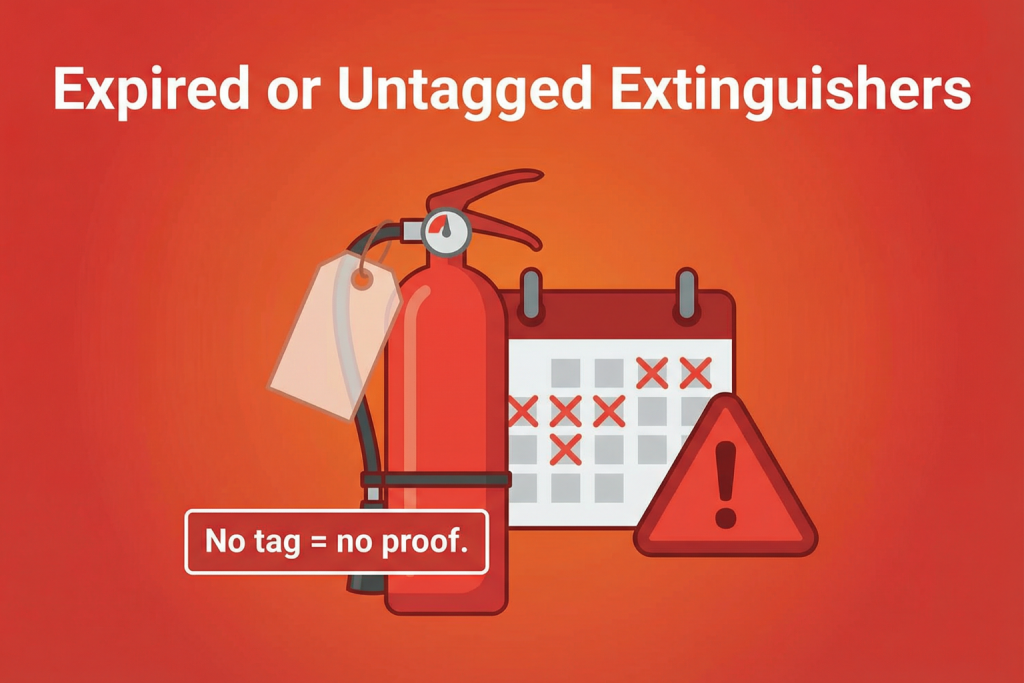
Expired or untagged extinguishers
Not having current tags/records is one of the fastest ways to fail “readiness” checks.
Blocked exits or cluttered escape paths
Storage overflow, trash staging, and seasonal inventory are frequent causes.
Missing or outdated evacuation maps
Maps often don’t get updated after renovations or tenant layout changes.
Nonfunctional alarms or ignored trouble signals
A panel can be “beeping” for weeks and nobody owns the escalation.
Lack of employee fire-safety education
Even with equipment, confusion or panic creates risk.
Not meeting local, state, or industry-specific requirements
NYC and NJ enforcement expectations differ plan for site-specific compliance instead of copy-pasting procedures.
Stat Graph: Extinguisher effectiveness (when equipment is ready)
NFPA-cited materials referencing NAFED data report a 95% success rate in that dataset.
Not succeeded: 5%
Meaning: extinguishers can be highly effective — but only if they’re maintained, accessible, and ready when seconds count.
Stat Graph 2: Human performance with extinguishers (why training pays off)
Summary stats (WPI/EKU fact sheet): 98% basic operation, 74% proper technique, and ~13.4 sec average discharge time.
seconds
Bars scaled 0–100%
Meaning: even short, consistent training can dramatically improve outcomes — especially technique (aiming at the base and sweeping).
Table 2: Inspection + recordkeeping schedule (simple version)
(Exact intervals can vary by extinguisher type and local requirements, but this gives your internal “rhythm.”)
Fire extinguisher frequency checklist (who does what + what proof to keep)
A quick view of routine checks, scheduled maintenance, post-use actions, and type-based due events.
📁 Proof-focused
Tip: Store all evidence (checklists + service records) in one place and name files by site + floor/area + date for faster audits.
Table 3: “Most common fail points” matrix (with fixes that actually stick)
This is designed to reduce repeat violations.
Common fail points (why they happen + fixes that prevent repeat problems)
Use this as a quick “audit rescue” checklist and a long-term prevention plan.
✅ Prevent repeat
Tip: If you only pick one “better fix,” start with a master list + recurring reminders — it prevents more repeat failures than any single checklist.
Tips to maintain ongoing compliance (without losing your mind)
Run routine facility walkthroughs (micro-audits)
Make it fast:
- Egress clear
- Extinguishers visible
- Alarm issues escalated
- Maps posted
Partner with certified professionals for inspections and system maintenance
If you want predictable inspection readiness, keep service standardized. For equipment help and scheduling, your main hub is: https://anjfire.com/fire-extinguisher/
Keep digital AND physical logs
Physical binder helps on-site inspections; digital helps with multi-site oversight.
Conduct drills (short, role-based)
Assign:
- who calls 911
- who checks washrooms (if safe)
- where the assembly point is
- who meets responders
Replace or service equipment immediately when issues arise
Delaying small problems creates bigger ones during inspection week.
For temporary compliance coverage (events, short-term sites, seasonal operations), rentals can simplify planning:
https://anjfire.com/fire-extinguisher-rental/
Table 4: Business-type priorities (what to focus on first)
Business type priorities (risk hot spots + what to focus on this month)
A fast way to pick the highest-impact actions based on your building’s use.
✅ Monthly focus
Tip: Choose one priority per month and track it building-wide — consistency beats sporadic “big cleanups.”
Compliance Risk Scorecard (copy/paste scoring)
This is a simple internal risk assessment tool: score each line 0–2.
- 0 = good, 1 = needs attention, 2 = urgent
Table 5: Scorecard
Compliance scorecard (0–2 per line item)
Use this as a quick monthly snapshot. Score each row: 0 = not OK, 1 = needs attention, 2 = solid.
📌 Track notes
1 = needs attention
2 = solid
Interpretation:
- 0–4 = stable
- 5–8 = fix within 14 days
- 9–14 = high risk (treat as urgent)
Table 6: 90-Day Compliance Sprint (implementation plan)
90-day compliance reset timeline (simple actions → audit-ready outputs)
A step-by-step plan to stabilize equipment, documentation, training, and drills in one quarter.
✅ Output-driven
Tip: Treat “Outputs” as your audit folder checklist — if the output exists and is current, you’re usually ahead of most inspections.
Table 7: Documentation Pack (what inspectors love)
Set this up once; it reduces stress forever.
“Inspection-ready” binder tabs (what to keep + where to keep it)
A clean structure you can copy for a physical binder and a matching shared drive folder.
✅ Audit-friendly
Pro move: mirror these tabs in a shared drive and name files by site + floor/area + date.
OSHA notes: keep maintenance records accessible
For NYC-specific signage pitfalls, link your team here and use it as a pre-inspection checklist:
https://anjfire.com/common-fire-sign-violations-nyc/
Optional equipment note (space + aesthetics)
For tighter spaces and cleaner installs in customer-facing areas, oval units can make placement easier while keeping visibility high:
https://anjfire.com/oval-fire-extinguishers/
FAQ
What are the fire safety requirements for commercial buildings?
Requirements vary by occupancy and hazards, but typically include maintained extinguishers, clear exits, required alarm/detection/suppression systems, training/drills, and documented inspection/maintenance. In NYC, the Fire Code applies broadly and sets requirements for buildings and businesses. New York City Government
What does OSHA require for fire safety?
OSHA’s portable extinguisher standard requires an annual maintenance check, and it also addresses recording/retaining the maintenance record. OSHA
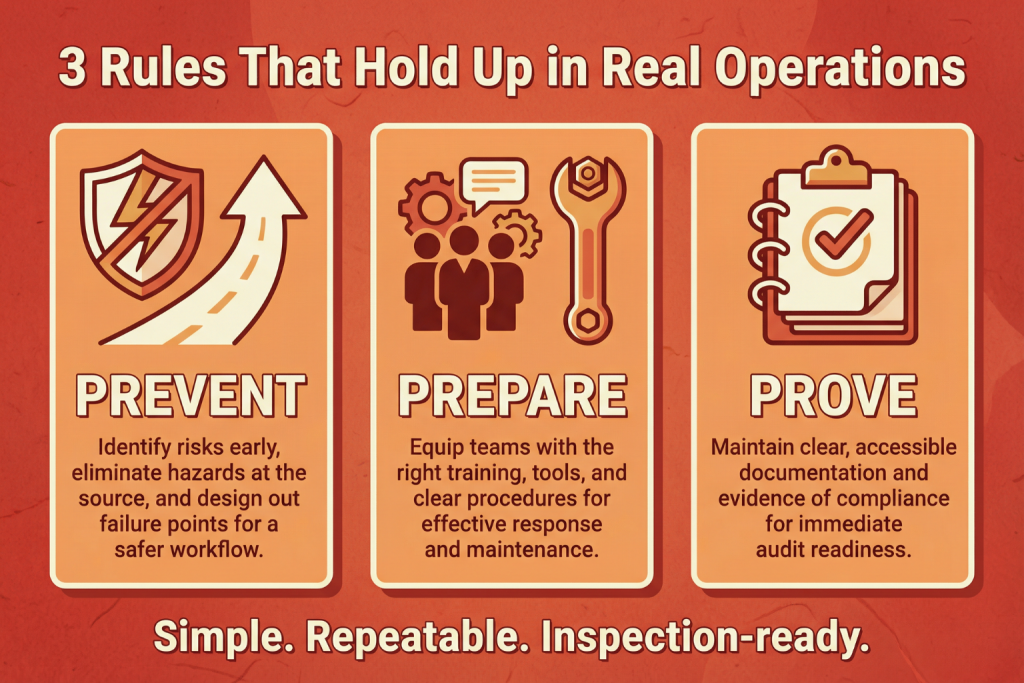
What are the three rules that companies follow in terms of fire safety?
A practical rule set that holds up in real operations:
- Prevent (reduce hazards + keep access clear)
- Prepare (train people + maintain systems)
- Prove (keep records)
What is fire safety compliance?
It’s the ongoing process of meeting applicable fire codes and safety regulations through maintained equipment, accessible egress, trained staff, drills, and documentation- not a one-time inspection event.
Conclusion
Consistent compliance reduces legal risk, protects staff and customers, and improves response speed during emergencies. The easiest way to stay “inspection-ready” is to run a simple system: routine walkthroughs, scheduled inspections, short training refreshers, and clean documentation.
If you want help scheduling inspections, updating equipment, and keeping year-round readiness across NY/NJ, start with your service hub: https://anjfire.com/fire-extinguisher/