Key Takeaways
- Class ABC extinguishers fight three fire types - ordinary combustibles (A), flammable liquids (B), and electrical fires (C) - with one unit
- Monoammonium phosphate is the dry chemical agent that smothers all three fire classes
- Ratings like 2A:10B:C indicate fighting capacity - higher numbers mean more fire coverage
- Required in most commercial buildings by NFPA 10 and enforced by the FDNY in NYC
- Not suitable for Class D metal fires or Class K kitchen fires - specialized extinguishers are needed for those hazards
The Class ABC fire extinguisher is the most widely used fire protection device in commercial buildings, offices, and homes across the United States. It's the multi-purpose workhorse that handles the three most common fire types you're likely to encounter - all in one red cylinder.
But what exactly does "Class ABC" mean? How does one extinguisher fight three completely different types of fires? And how do you know if your building has the right ABC extinguisher for the hazards present? This guide breaks it down.
What Is a Class ABC Fire Extinguisher?
A Class ABC fire extinguisher is a multi-purpose dry chemical extinguisher that uses monoammonium phosphate as its extinguishing agent. It's designed to fight three classes of fire:
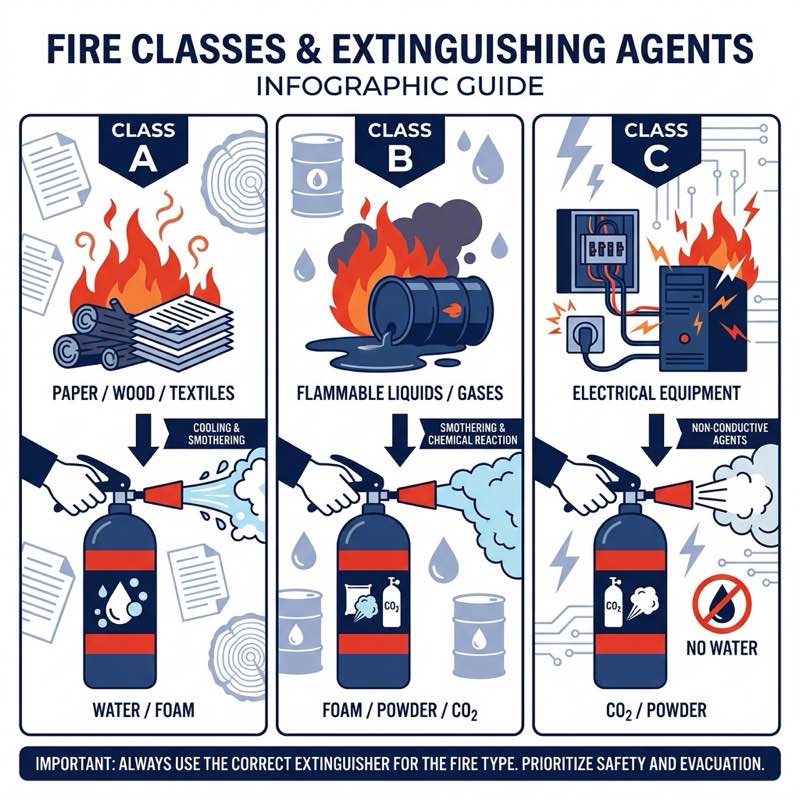
| Fire Class | Fuel Type | Examples | How ABC Agent Works |
|---|---|---|---|
| Class A | Ordinary combustibles | Wood, paper, cloth, trash, rubber | Cools and coats fuel surface, smothering the fire |
| Class B | Flammable liquids | Gasoline, oil, paint, solvents | Creates a barrier between fuel and oxygen |
| Class C | Electrical equipment | Energized wiring, panels, appliances | Non-conductive agent prevents electrical shock |
The key advantage of a Class ABC extinguisher is versatility. Most commercial and residential spaces contain a mix of Class A, B, and C hazards. Instead of needing three different extinguishers, one ABC unit covers them all. This simplifies placement, training, and maintenance.
How the ABC Rating System Works
Every fire extinguisher has a numerical rating printed on the label. For Class ABC extinguishers, the rating looks something like 2A:10B:C. Here's what each part means:
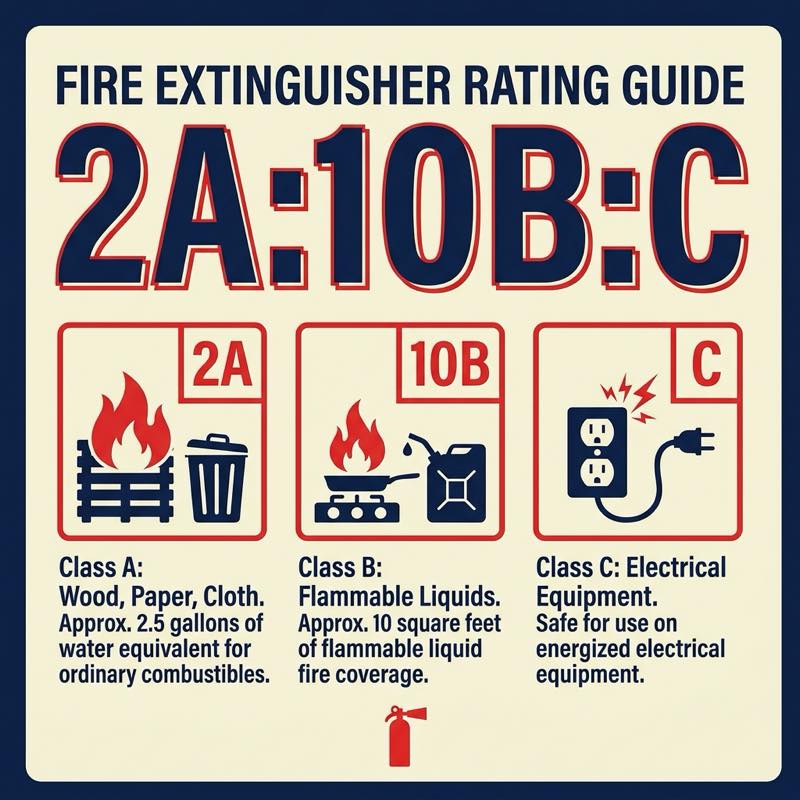
- The number before "A" indicates the extinguisher's capacity against Class A fires. Each A unit equals 1.25 gallons of water equivalent. A 2A rating means the unit provides the equivalent of 2.5 gallons of water.
- The number before "B" indicates the square footage of flammable liquid fire the unit can handle. A 10B rating means the extinguisher can put out a 10-square-foot flammable liquid fire.
- "C" means the agent is electrically non-conductive and safe for use on live electrical equipment. There is no number before C - it's either rated C or it's not.
Common ABC Extinguisher Sizes and Ratings
A 5-pound ABC unit typically rated 2A:10B:C is the standard for offices, retail stores, and general commercial spaces. A 10-pound ABC unit rated 4A:60B:C provides more capacity for larger areas, warehouses, and industrial spaces. A 2.5-pound ABC unit rated 1A:5B:C is suitable for vehicles, small rooms, and residential kitchens.
Where Class ABC Fire Extinguishers Are Required
NFPA 10 requires that fire extinguishers be provided based on the hazard classification of the area. In most commercial and public buildings, Class ABC extinguishers are the standard because the hazard mix includes ordinary combustibles, flammable liquids, and electrical equipment:
- Office buildings - Paper, furniture, electrical equipment, cleaning solvents
- Retail stores - Merchandise, packaging, electrical displays, storage areas
- Restaurants - Dining areas (kitchens need separate Class K units)
- Hotels and motels - Guest rooms, lobbies, hallways, utility rooms
- Apartment buildings - Common areas, hallways, laundry rooms, storage
- Schools and daycares - Classrooms, offices, cafeterias, storage
- Healthcare facilities - Patient rooms, offices, utility closets
In New York City, the FDNY enforces these requirements and conducts random spot checks. Building owners must have the correct type, number, and placement of extinguishers - with current inspection tags - or face fines starting at $1,000 per violation.
When NOT to Use a Class ABC Extinguisher
While Class ABC extinguishers handle the most common fire types, there are important exceptions:
- Class D fires - Combustible metal fires (magnesium, sodium, titanium) require specialized Class D extinguishers with specific dry powder agents. ABC chemical can actually make metal fires worse.
- Class K fires - Commercial kitchen cooking oil and grease fires require wet chemical Class K extinguishers. ABC chemical is not effective on deep fat fryer fires.
- Sensitive electronic equipment - The dry chemical residue from an ABC extinguisher is corrosive and difficult to clean. For server rooms and clean rooms, clean agent extinguishers (Halotron) are preferred.
ABC Residue Cleanup
Monoammonium phosphate leaves a yellow, powdery residue that is mildly corrosive. If not cleaned promptly, it can damage electronics, metals, and finished surfaces. After using an ABC extinguisher, clean the residue as soon as possible using dry methods first (vacuum, brush), then damp cleaning. Always wear a dust mask during cleanup.
Maintenance and Inspection Requirements
Like all portable fire extinguishers, Class ABC units require regular maintenance according to NFPA 10:
- Monthly visual inspection - Check the pressure gauge, safety pin, tamper seal, and general condition. Anyone can do this.
- Annual professional inspection - Certified technician performs full inspection with documentation and tagging. A&J Fire provides FDNY-certified annual inspections.
- 6-year internal examination - For rechargeable units, the dry chemical agent is dumped and the interior is inspected for corrosion or damage.
- 12-year hydrostatic testing - The cylinder is pressure-tested to verify structural integrity. If it passes, the unit is refilled and returned to service.
- Monthly shaking - The dry chemical powder can settle and compact over time. Turn the extinguisher upside down and shake it once a month to keep the agent loose.
How to Use a Class ABC Fire Extinguisher (PASS Method)
If you need to use an ABC extinguisher, remember the PASS method:
- Pull the safety pin to break the tamper seal
- Aim the nozzle low at the base of the fire, not at the flames
- Squeeze the top handle to discharge the agent
- Sweep the nozzle from side to side across the base of the fire
Stand 6 to 8 feet away from the fire and always keep a clear exit behind you. A standard 5-pound ABC unit discharges in about 10 to 15 seconds, so act quickly and efficiently. If the fire is too large or spreading, evacuate immediately and call 911 - don't risk your life fighting a fire that's beyond your extinguisher's capacity.
Professional Fire Extinguisher Sales and Service from A&J Fire
For buildings and businesses in the New York City metro area, A&J Fire Extinguisher provides complete fire safety services:
- ABC extinguisher sales - We supply the right size and rating for your specific hazard
- FDNY-certified installation - Proper mounting height, placement, and compliance tagging
- Annual inspections and maintenance - Keep your units compliant year after year
- Recharging service - If your ABC unit is discharged, we recharge it on the spot
- Fire safety assessments - We evaluate your building and recommend the correct extinguisher types, sizes, and placements
Don't guess which extinguisher your building needs. Contact A&J Fire or call us directly for a professional fire safety assessment.
Our team at A&J Fire provides fire extinguisher sales and service, FDNY-certified inspections, and recharge services across all five NYC boroughs. Learn about Class D extinguishers for combustible metal hazards. Call (718) 852-2762 to order today. The Class A component handles ordinary combustible fires involving wood, paper, and cloth.
Frequently Asked Questions
A Class ABC fire extinguisher is a multi-purpose dry chemical extinguisher that fights three types of fires: Class A (ordinary combustibles like wood, paper, and cloth), Class B (flammable liquids like gasoline, oil, and grease), and Class C (electrical fires involving energized equipment). It uses monoammonium phosphate as the extinguishing agent, which smothers the fire and creates a barrier between the fuel and oxygen. It is the most common extinguisher found in commercial buildings, offices, and homes.
The rating - such as 2A:10B:C - tells you the extinguisher's fighting capacity. The number before 'A' indicates how much water equivalent the unit provides (1A = 1.25 gallons of water). The number before 'B' indicates the square footage of flammable liquid fire it can handle (10B = 10 square feet). The 'C' simply means the agent is electrically non-conductive and safe for use on live electrical equipment. Higher numbers mean greater fire-fighting capacity. A typical 5-pound ABC unit rated 2A:10B:C is adequate for most offices and commercial spaces.
NFPA 10 requires Class ABC fire extinguishers in most commercial and public buildings where ordinary combustibles, flammable liquids, and electrical equipment are present. This includes offices, retail stores, restaurants, hotels, apartment buildings, schools, and healthcare facilities. In New York City, the FDNY requires that all commercial buildings have appropriate fire extinguishers installed and maintained. The specific number and placement depend on the building's occupancy classification and floor area.
No. While Class ABC extinguishers handle the three most common fire types, they are not suitable for all fires. Do not use ABC dry chemical extinguishers on Class D (combustible metal) fires, Class K (cooking oil and grease) fires in commercial kitchens, or fires involving sensitive electronic equipment where the dry chemical residue could cause damage. Water-based or foam extinguishers should not be used on Class B or C fires. Always match the extinguisher class to the hazard in the area.
Use the PASS method: Pull the safety pin, Aim the nozzle at the base of the fire, Squeeze the handle to discharge, and Sweep side to side across the fire base. Stand 6 to 8 feet from the fire and always keep your back to an exit so you can escape if the fire spreads. A typical 5-pound ABC unit discharges in about 10 to 15 seconds, so you have limited time. If the fire is too large, evacuate immediately and call 911.
Need Class ABC Fire Extinguishers?
Sales, installation, FDNY-certified inspections, and recharging - serving Brooklyn, Queens, Manhattan, Bronx, Staten Island, Long Island & New Jersey since 1965.
(718) 852-2762