A Class D fire extinguisher is the only safe way to fight a combustible metal fire. Using water, foam, CO₂, or standard dry chemical agents on burning magnesium, sodium, or titanium can cause violent explosions - making the emergency more dangerous than the original fire. This guide covers exactly which Class D extinguishers exist, how they work, what metals they cover, and where they're legally required.
Key Takeaways
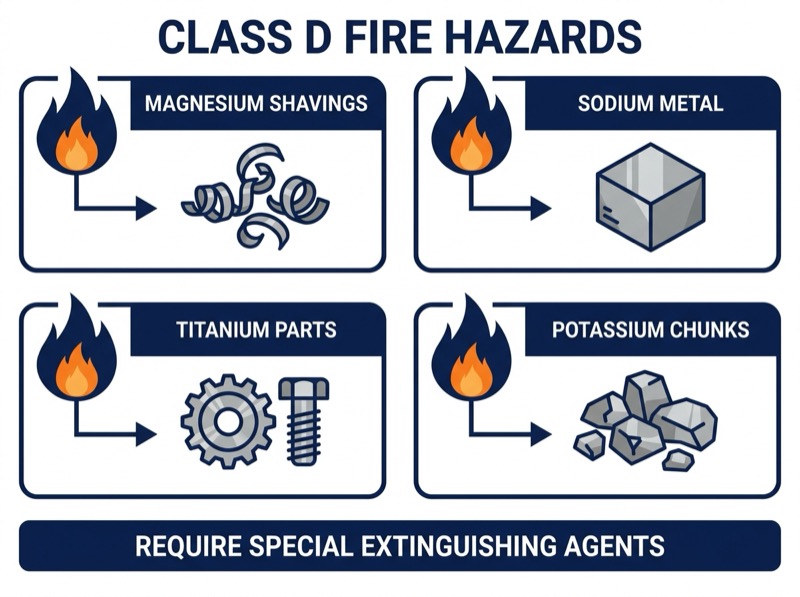
- Class D extinguishers fight combustible metal fires only - magnesium, sodium, potassium, titanium, lithium, and zirconium
- Never use water on a Class D fire - it causes violent chemical reactions and explosions
- Sodium chloride and copper powder are the two primary extinguishing agents for Class D
- NFPA 10 requires Class D extinguishers within 50 feet of combustible metal hazards
- OSHA mandates Class D protection in any facility that processes, stores, or machines combustible metals
What Is a Class D Fire?
A Class D fire involves combustible metals that ignite under specific conditions - typically as fine particles, shavings, or dust. Unlike ordinary combustible fires (Class A) or flammable liquid fires (Class B), metal fires burn at extraordinary temperatures and generate their own oxygen supply, making them nearly impossible to extinguish with standard methods.
Common combustible metals include:
- Magnesium - widely used in automotive and aerospace parts; shavings and dust ignite at 883°F
- Sodium - used in chemical manufacturing; reacts explosively with water
- Potassium - common in laboratories and pharmaceutical manufacturing
- Titanium - aerospace and medical device manufacturing; dust fires burn at 5,900°F
- Lithium - battery manufacturing and energy storage; increasingly common hazard
- Zirconium - nuclear and chemical processing industries
- Calcium - metallurgy and chemical production
These metals don't just burn - they react. Magnesium fires burn so hot they split water into hydrogen and oxygen, feeding the fire. Sodium and potassium react with moisture in the air, spontaneously igniting in humid conditions. This is why standard extinguishers are not just ineffective on Class D fires - they're dangerous.
⚠️ Critical Warning: Never use water, foam, CO₂, or standard ABC dry chemical extinguishers on a combustible metal fire. Water causes hydrogen gas explosions with burning sodium and potassium. CO₂ can cause a chemical reaction with some burning metals that produces toxic gases. Only Class D extinguishers with the correct dry powder agent are safe.
How Class D Fire Extinguishers Work
Class D extinguishers use specialized dry powder agents - not the dry chemical found in ABC extinguishers. The two primary agents work differently:
Sodium Chloride-Based Agent (NaCl)
Sodium chloride-based dry powder is the most common Class D extinguishing agent. When applied to a burning metal fire, the heat melts the salt into a glass-like crust that smothers the fire by cutting off oxygen. This crust also conducts heat away from the burning metal, helping to cool it gradually. Sodium chloride agents are effective on magnesium, sodium, potassium, and sodium-potassium alloy fires.
Copper Powder Agent (Cu)
Copper-based dry powder is specifically designed for lithium and lithium-alloy fires. The copper particles form a heat-absorbing, oxygen-blocking crust that also prevents the lithium from re-igniting. Copper powder is the only NFPA-recommended agent for lithium fires because sodium chloride does not effectively crusting with lithium - the fire can burn through a NaCl crust.
Graphite-Based Agent
Some Class D extinguishers use graphite-based powder for lithium and certain metal hydride fires. Graphite provides excellent heat absorption and forms a smothering layer, but it's less common than copper powder for lithium applications.
Class D Extinguisher Types and Ratings
Class D extinguishers are rated by the specific metals they cover and their discharge capacity. Unlike ABC extinguishers that use numerical ratings (like 2A:10B:C), Class D units use a simpler system based on the agent type and discharge duration.
| Agent Type | Effective On | Common Size | Discharge Time |
|---|---|---|---|
| Sodium Chloride (NaCl) | Magnesium, Sodium, Potassium, NaK Alloys | 30 lb | 30–45 seconds |
| Copper Powder (Cu) | Lithium, Lithium Alloys | 30 lb | 30–45 seconds |
| Graphite Powder | Lithium, Metal Hydrides | 30 lb | 30–45 seconds |
| Granular G-1 Powder | Uranium, Plutonium (specialized) | Variable | Extended |
💡 Matching the Agent to the Metal: Using the wrong Class D agent can be ineffective or dangerous. Sodium chloride on a lithium fire may not form a proper crust, allowing re-ignition. Always match the extinguisher agent to the specific combustible metal hazard in your facility. Check the extinguisher label for the list of approved metals.
Where Class D Fire Extinguishers Are Required
Both NFPA 10 and OSHA 29 CFR 1910.157 require Class D extinguishers in facilities that handle combustible metals. Here's where they're mandatory:
- Metal fabrication shops - machining, grinding, and cutting magnesium, titanium, or aluminum alloys
- Foundries and casting operations - molten metal handling and pouring operations
- Aerospace manufacturing - titanium and magnesium component production and finishing
- Automotive parts plants - magnesium wheel and transmission case machining
- Battery manufacturing - lithium-ion and lithium-metal battery production
- Chemistry laboratories - sodium, potassium, and other reactive metal storage and handling
- Recycling facilities - metal scrap processing, especially magnesium and titanium turnings
- Pharmaceutical manufacturing - processes using sodium and potassium reagents
NFPA 10 Placement Requirements
NFPA 10 specifies that Class D extinguishers must be placed within 50 feet of travel distance from the combustible metal hazard. The travel distance can extend to 75 feet for certain lower-hazard commercial operations. Extinguishers should be mounted on walls or stands in clearly marked, accessible locations - not blocked by equipment or stored items.
OSHA Compliance
Under OSHA 29 CFR 1910.157, employers must provide portable fire extinguishers appropriate for the fire hazards present. If combustible metals are in use, Class D extinguishers are not optional - they're a legal requirement. Failure to maintain appropriate fire extinguishers can result in OSHA citations of up to $16,131 per violation.
Class D vs Other Fire Classes
Understanding how Class D fits into the complete fire classification system helps clarify why these extinguishers are so specialized:
| Fire Class | Fuel Type | Extinguishing Agent | Danger with Metal Fires |
|---|---|---|---|
| Class A | Ordinary combustibles (wood, paper) | Water, foam, ABC dry chemical | Water reacts explosively |
| Class B | Flammable liquids | Foam, CO₂, dry chemical | CO₂ + metal = toxic gas |
| Class C | Electrical equipment | CO₂, dry chemical | Ineffective on metal |
| Class D | Combustible metals | Dry powder (NaCl, Cu, graphite) | Correct agent |
| Class K | Cooking oils & fats | Wet chemical | Ineffective on metal |
How to Use a Class D Fire Extinguisher
Using a Class D extinguisher requires a different technique than standard ABC extinguishers. Follow this modified PASS procedure:
- Pull the safety pin and break the tamper seal
- Aim the nozzle at the base of the burning metal - not the flames
- Squeeze the handle to begin the dry powder discharge
- Sweep the nozzle slowly across the base of the fire, building a continuous crust of powder over the burning metal
💡 Technique Difference: Unlike ABC extinguishers where you sweep rapidly, Class D extinguishers require a slow, deliberate application. The goal is to build a thick crust of dry powder that completely covers the burning metal. If you sweep too fast, the powder scatters and the crust won't form - allowing the metal to re-ignite through gaps. Apply the powder in a steady, overlapping pattern.
Inspection and Maintenance
Class D extinguishers require the same inspection schedule as other portable extinguishers, per NFPA 10:
- Monthly visual inspection - check that the extinguisher is in place, the gauge reads properly, the pin and seal are intact, and no physical damage is visible
- Annual professional inspection - certified technician verifies agent weight, internal pressure, nozzle condition, and overall functionality
- Internal examination every 5 years - the extinguisher is opened, the dry powder agent is inspected for caking or moisture damage, and the cylinder is examined for corrosion
- Hydrostatic testing every 12 years - the cylinder is pressure-tested to verify structural integrity
If the dry powder agent shows any signs of caking, moisture, or hardening, the extinguisher must be serviced immediately - the agent may not discharge properly in an emergency. For NYC-area facilities, A&J Fire Extinguisher provides certified Class D inspection and maintenance services.
Class D Fire Extinguisher Cost
Class D extinguishers are more expensive than standard ABC units due to the specialized dry powder agents and heavier-duty construction required to handle extreme heat. Typical costs:
- 30 lb sodium chloride unit: $350–$550
- 30 lb copper powder unit: $500–$800
- 150 lb wheeled unit (large facilities): $1,500–$2,500
While the initial investment is higher, the cost of not having the right extinguisher - property damage, injuries, OSHA fines, and potential fatalities - is exponentially greater. Most facilities need only one or two Class D units positioned near the combustible metal work areas. For commercial kitchen fires involving cooking oils, a Class K fire extinguisher is the correct choice instead of Class D. For flammable liquid fires, a Class B fire extinguisher handles fuel and oil-based fires rather than combustible metals.