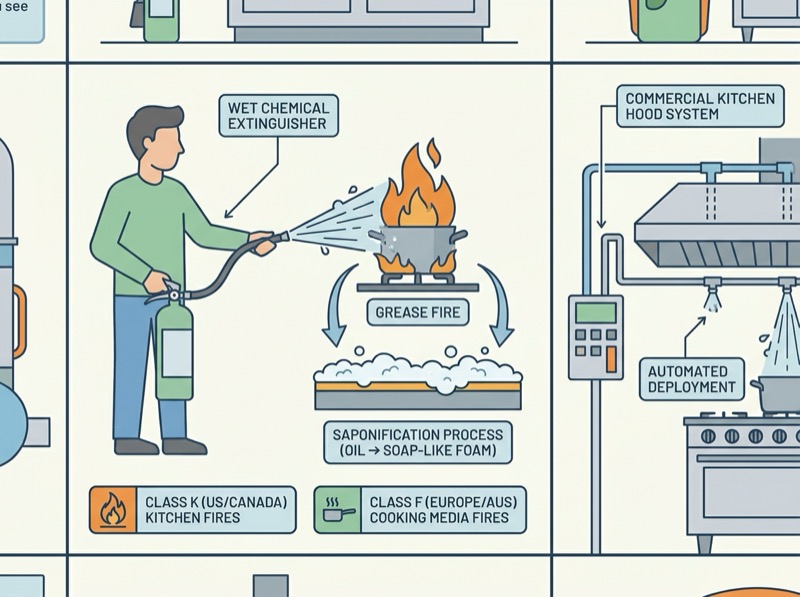
A wet chemical fire extinguisher is the only extinguisher type specifically designed for commercial kitchen fires involving cooking oils and fats. These Class K fires burn at extreme temperatures - oil heated above 685°F auto-ignites and creates a fire that standard ABC extinguishers cannot reliably suppress. The wet chemical agent works through a unique process called saponification that both extinguishes the fire and prevents re-ignition. This guide covers everything you need to know: how they work, where they're required, and how they differ from every other extinguisher type.
Key Takeaways
- Wet chemical extinguishers are for Class K fires - cooking oils and fats in commercial kitchens
- Saponification creates a soapy foam that cools oil and blocks oxygen simultaneously
- ABC extinguishers cannot prevent re-ignition of deep fat fryer fires - they don't cool the oil
- NFPA 10 requires Class K extinguishers within 30 feet of commercial cooking appliances
- NFPA 96 mandates hood suppression systems with wet chemical agents in most commercial kitchens
What Is a Wet Chemical Fire Extinguisher?
A wet chemical fire extinguisher contains a potassium-based solution - typically potassium acetate, potassium citrate, or a combination - stored as a liquid under pressure. When discharged, the agent sprays as a fine mist that reacts with burning cooking oil to create a thick, soapy foam. This foam is the key to the extinguisher's effectiveness against Class K fires.
Wet chemical extinguishers are easily identified by:
- Gold/silver labeling with "Class K" clearly marked
- Flexible hose wand - not a rigid nozzle - for precise application over fryer edges
- Larger size - typically 6-liter (1.6 gallon) capacity for commercial kitchens
- Low-pressure discharge - the fine mist pattern avoids splashing hot oil
The low-pressure, fine-mist discharge is critical. High-pressure extinguishers (like ABC dry chemical) can actually splash burning oil out of the fryer when aimed at the surface, spreading the fire instead of containing it. The gentle mist of a wet chemical unit coats the oil surface without disturbing it.
How Saponification Works
Saponification is the chemical reaction that makes wet chemical extinguishers uniquely effective on grease fires. Here's the science in plain terms:
- The agent contacts the burning oil - the fine potassium acetate mist settles on the oil surface
- Chemical reaction begins - the alkaline potassium compound reacts with fatty acids in the cooking oil
- Soapy foam forms - this reaction creates a soap-like substance (the same basic chemistry used to make soap from fat and lye)
- Foam blanket spreads - the soapy layer expands and covers the entire oil surface
- Two extinguishing mechanisms: the foam cools the oil below its auto-ignition temperature (typically from 700°F+ down to below 400°F) and blocks oxygen from reaching the burning surface
- Re-ignition prevented - as long as the foam blanket remains intact, the oil cannot re-ignite
This is fundamentally different from how other extinguishers work. ABC dry chemical only suppresses the flames by interrupting the chemical chain reaction - it does not cool the oil. The oil remains at ignition temperature, and as soon as the chemical cloud dissipates (within 15-30 seconds), the fire re-ignites. This is why ABC extinguishers have a documented re-ignition rate of over 60% on deep fat fryer fires.
⚠️ Never Use Water on a Grease Fire: Water instantly boils when it hits hot oil (oil at 700°F vs water boiling at 212°F). The violent steam explosion blasts burning oil in all directions - onto walls, ceilings, and people. This is how small kitchen fires become catastrophic building fires. A wet chemical extinguisher applies a fine mist that avoids this reaction.
Class K vs Class F: International Differences
If you've seen Class F referenced in fire safety materials, it's the same fire category - just under a different classification system:
| System | Classification | Fuel Type | Region |
|---|---|---|---|
| NFPA (US) | Class K | Cooking oils & fats | United States |
| EN/BS (Europe) | Class F | Cooking oils & fats | Europe, UK, Australia |
| AS/NZS (Aus/NZ) | Class F | Cooking oils & fats | Australia, New Zealand |
The extinguishing agent and principle are the same - wet chemical saponification. The only difference is the label and the classification system used in each region. If you're purchasing equipment for a US facility, look for Class K on the label.
When Wet Chemical Extinguishers Are Required
NFPA 10 and NFPA 96 establish clear requirements for Class K extinguisher placement:
NFPA 10 Requirements
- Class K extinguishers must be provided wherever commercial cooking appliances use vegetable or animal cooking oils or fats
- Extinguishers must be located within 30 feet of travel distance from the cooking appliance
- The Class K extinguisher supplements (not replaces) the pre-engineered hood suppression system
- Buildings that have installed hood suppression systems must also maintain portable Class K extinguishers for spot fires or fires that the suppression system doesn't reach
NFPA 96 Hood Suppression Requirements
NFPA 96 goes further, requiring automatic wet chemical suppression systems in the hood above commercial cooking equipment. These fixed systems are different from portable extinguishers - they're permanently installed tanks with nozzles positioned over fryers, griddles, and ranges. When a fire is detected (via fusible links or heat sensors), the system automatically discharges wet chemical agent onto the cooking surface.
Key NFPA 96 requirements:
- All deep fat fryers, griddles, and ranges in commercial kitchens must be protected by a hood suppression system
- Suppression systems must be inspected semi-annually by a certified technician
- Fusible links or detection devices must be replaced annually
- The suppression system must be interconnected to shut off gas and electrical power to the cooking equipment upon activation
FDNY Requirements (NYC)
In New York City, the FDNY adds additional requirements beyond NFPA standards:
- All NYC commercial kitchens must have both a hood suppression system AND a portable Class K extinguisher
- Hood systems must be inspected and tagged by an FDNY-authorized provider - a UL-listed inspection alone is not sufficient
- Class K extinguishers must carry a current annual inspection tag from an FDNY-certified company
- Food trucks and mobile vendor kitchens also require Class K protection under NYC code
A&J Fire Extinguisher provides FDNY-certified inspections for both portable Class K extinguishers and hood suppression systems throughout Brooklyn and NYC. Call (718) 852-2762 to schedule an inspection.
Wet Chemical vs ABC: Why the Wrong Extinguisher Is Dangerous
Many restaurants still rely on ABC extinguishers in their kitchens - and it's a serious safety risk. Here's the detailed comparison:
| Feature | Wet Chemical (Class K) | ABC Dry Chemical |
|---|---|---|
| Design purpose | Cooking oil & fat fires | General-purpose fires |
| Agent | Potassium acetate solution | Monoammonium phosphate powder |
| Cools burning oil? | Yes - rapid cooling | No - powder does not cool |
| Prevents re-ignition? | Yes - foam blanket | No - 60%+ re-ignition rate |
| Splash risk? | Low - fine mist | High - high-pressure blast |
| Cleanup | Moderate - soapy residue | Extreme - powder everywhere |
| Food contamination | Easier - residue is washable | Severe - powder contaminates all food |
| NFPA compliant? | Yes - required | No - not certified for Class K |
💡 Bottom Line: An ABC extinguisher in a commercial kitchen is a code violation and a safety hazard. It provides a false sense of security while being the wrong tool for the job. Every commercial kitchen needs at least one Class K extinguisher within 30 feet of the cooking equipment.
Types of Wet Chemical Extinguishers
Wet chemical extinguishers come in two main form factors:
Portable Class K Units
Handheld portable extinguishers rated 6L (1.6 gallons) for spot fires and emergency backup. These are the units that hang on the wall near the fryer station. Typical discharge time is 40–60 seconds, enough to handle most single fryer fires and provide initial response while the hood system activates.
Fixed Hood Suppression Systems
Permanently installed tanks (typically 20–100 lb capacity) connected to a network of nozzles above each cooking appliance. These systems activate automatically when a fusible link melts or a heat detector triggers, discharging wet chemical agent directly onto the burning surface. They also shut off gas and electrical supply to all kitchen equipment simultaneously.
Pre-Engineered Systems
The most common hood suppression systems are pre-engineered - meaning they're designed as complete packages by the manufacturer (Pyrone, Ansul, Kidde) with specific nozzle placement, pipe sizing, and agent quantities. These don't require custom engineering for each kitchen as long as the installation follows the manufacturer's design manual.
Inspection and Maintenance Schedule
Wet chemical extinguishers - both portable and fixed systems - require regular maintenance to remain effective and compliant:
Portable Class K Extinguishers
- Monthly: Visual check - verify the extinguisher is in place, gauge is in the green zone, pin and seal intact, no visible damage
- Annually: Professional inspection - certified technician checks agent weight, pressure, nozzle condition, hose integrity, and applies current inspection tag
- 5-Year: Internal examination - the agent is tested for pH and contamination, the tank is checked for corrosion
- 12-Year: Hydrostatic test on the cylinder, or replacement
Hood Suppression Systems
- Semi-annually: NFPA 96 requires inspection by a certified technician every 6 months
- Annually: Replace fusible links and detection devices
- After any activation: The system must be fully recharged, inspected, and reset by a certified technician before the kitchen can resume cooking operations
💡 FDNY Tag Requirement: In NYC, both portable Class K extinguishers and hood suppression systems must display a current FDNY inspection tag. Expired tags result in FDNY violations and potential kitchen closure. Tags are valid for 12 months and must be renewed through an FDNY-authorized provider like A&J Fire Extinguisher.
Wet Chemical Extinguisher Cost
Class K extinguishers cost more than standard ABC units, but the investment is a fraction of the cost of a kitchen fire:
- 6L portable Class K: $150–$350
- Hood suppression system (installed): $2,000–$5,000+ depending on kitchen size
- Annual inspection (portable): $25–$50 per unit
- Semi-annual hood inspection: $150–$400 per system
- Recharge after discharge: $100–$250 for portable, $300–$800 for hood system
Compare this to the average cost of a commercial kitchen fire: $50,000–$250,000+ in damage, plus business interruption, lost inventory, and potential liability. The Class K extinguisher pays for itself the first time you need it. Wet chemical agents are the primary filling in Class K fire extinguishers, which are designed specifically for commercial kitchen fires. For comparison, dry chemical fire extinguishers use powder agents instead of liquid to suppress different fire types. While wet chemical units target kitchen fires, an ABC fire extinguisher provides broader coverage for general hazards.