In a Brooklyn office or apartment building, you should never be more than a quick sprint from a unit. The exact number your property needs depends on floor size, fire hazard level, and occupancy - not a single citywide formula. A&J Fire has spent three generations placing portable fire extinguishers in NYC buildings, and this guide breaks down the counting rules exactly as our technicians apply them. For official placement verification, our fire extinguisher inspection service documents every unit position against code.
Key Takeaways
- **75 feet is the magic number** - NFPA 10 requires a rated extinguisher within 75 feet of travel from any point in the building
- **Hazard level drives quantity** - light hazard spaces need fewer units than kitchens or workshops
- **Every floor needs its own coverage** - a unit on the floor below does not count
- **Match the rating to the risk** - K-rated for kitchens, CO2 for electrical rooms
- **FDNY expects documentation** - tags, dates, and placement records matter at inspection time
The 75-Foot Rule: NFPA 10's Baseline Answer
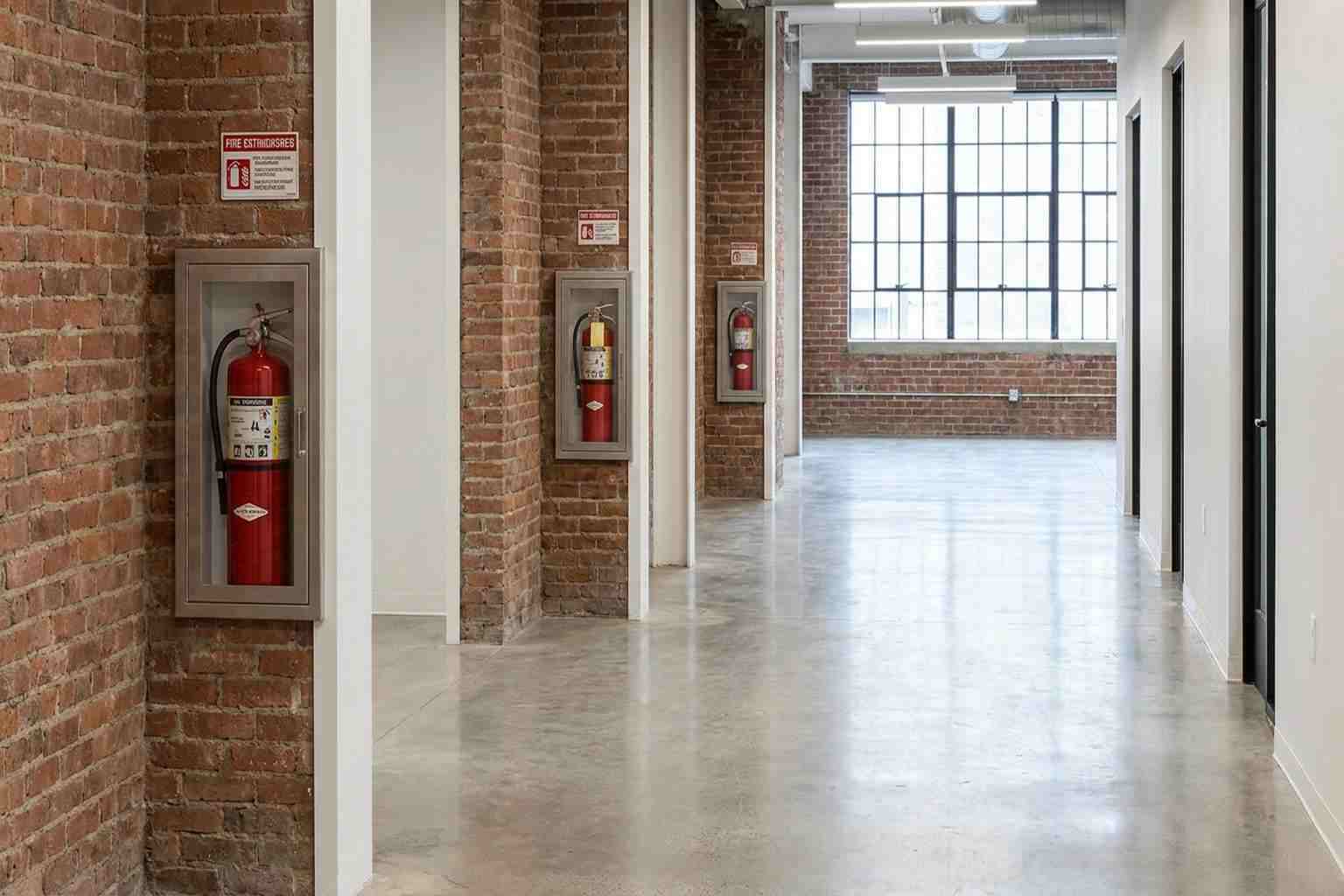
The National Fire Protection Association sets the standard most safety codes, including New York City's, build on. NFPA 10 states that the maximum travel distance to the nearest rated fire extinguisher is 75 feet. Stand anywhere, walk the shortest path along hallways and around partitions, and you reach a unit in 75 feet or less. Inspectors call this the extinguisher rule - it answers most how-many questions on its own.
A rectangular office floor of 120 by 80 feet needs at least two extinguishers - a single mid-floor unit leaves the corners beyond 75 feet. Walls, elevator banks, and locked rooms add units.
In older Brooklyn buildings, layouts twist around shaftways and dumbwaiter rooms, so the practical path is rarely straight. Measure actual walking routes, not the floor plan's diagonal.
How to Calculate Your Extinguisher Count
Start by classifying the space. NFPA 10 groups occupancies into three fire hazard levels, and the level sets both the minimum rating and the maximum coverage area per unit.
Light Hazard Occupancies
Offices, classrooms, churches, and waiting rooms fall here - few combustibles, small fires. One 2-A rated unit covers up to 3,000 square feet, with a minimum of one unit per floor.
Ordinary Hazard Occupancies
Most retail stores, auto showrooms, laundries, and light manufacturing spaces. One 2-A unit covers up to 1,500 square feet. Parking garages and restaurant front-of-house usually land in this band.
Extra Hazard Occupancies
Wood shops, upholstery floors, commercial kitchens, and areas with flammable liquids. One 4-A unit covers only 1,000 square feet, and local code often adds specific placements on top.
| Hazard Level | Typical Space | Coverage Per 2-A Unit | Min Rating |
|---|---|---|---|
| Light | Offices, classrooms | 3,000 sq ft | 2-A |
| Ordinary | Retail, garages | 1,500 sq ft | 2-A |
| Extra | Kitchens, workshops | 1,000 sq ft | 4-A |
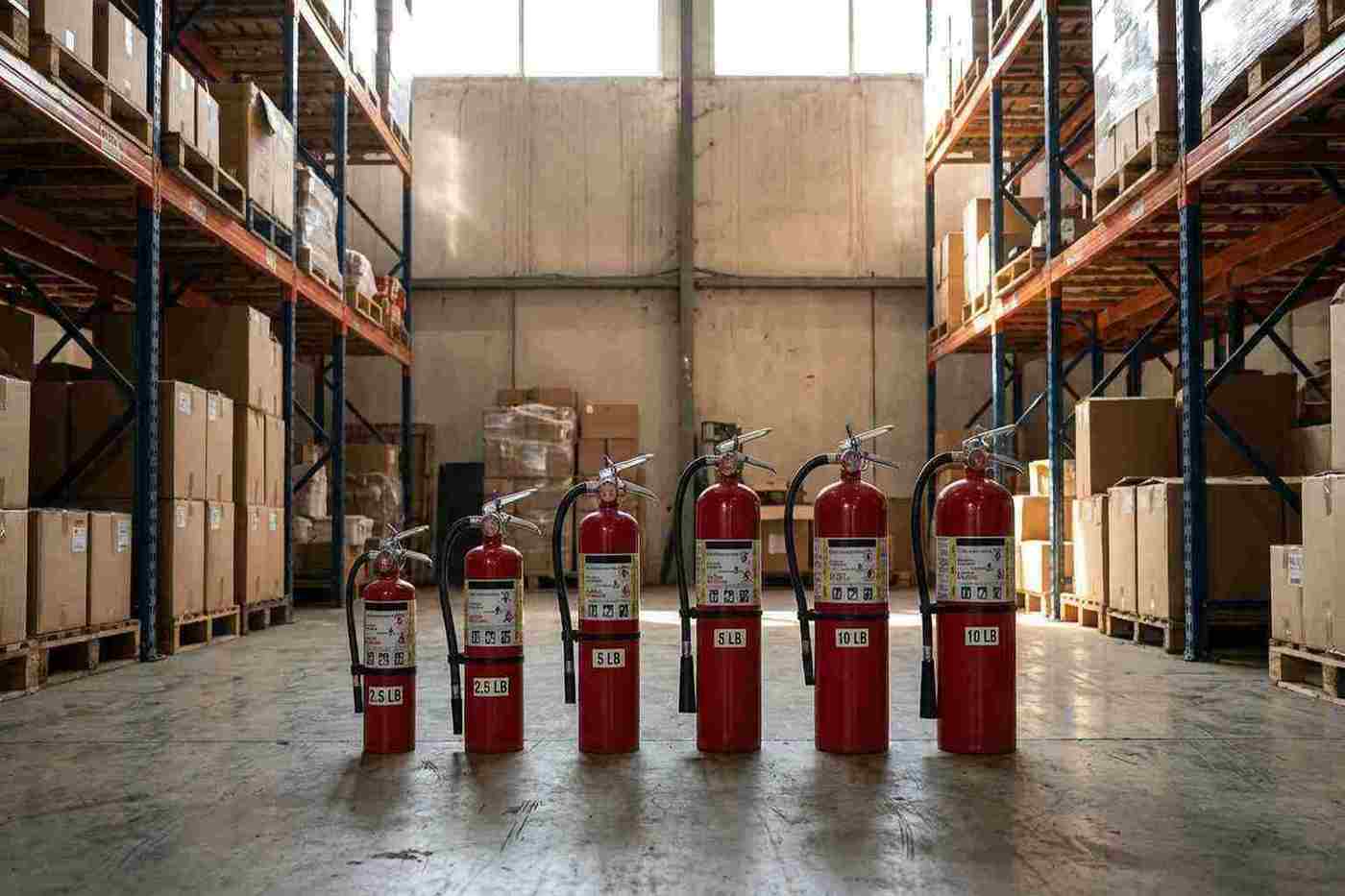
A 6,000-square-foot office needs two units by area, but the 75-foot rule may push it to three. A 10,000-square-foot warehouse needs seven before special hazards.
Match Each Unit to the Fire Risk
Count is only half the answer. Each unit must also carry the right rating for the hazards near it. A full breakdown lives in our types of fire extinguishers guide, but the short version:
- General areas: a multi-purpose ABC extinguisher handles trash, liquids, and live equipment
- Commercial kitchens: a Class K wet chemical unit within 30 feet of cooking appliances, required wherever fryers or grills operate
- Electrical and server rooms: rated CO2 or clean agent units that leave no residue on energized equipment
- Areas with flammable liquids: 10-B or 20-B rated units sized to the fuel quantity
A common mistake in mixed-use buildings: the right number of units, all ABC, but no K-rated unit near the kitchen line. Inspectors count that as a missing unit.
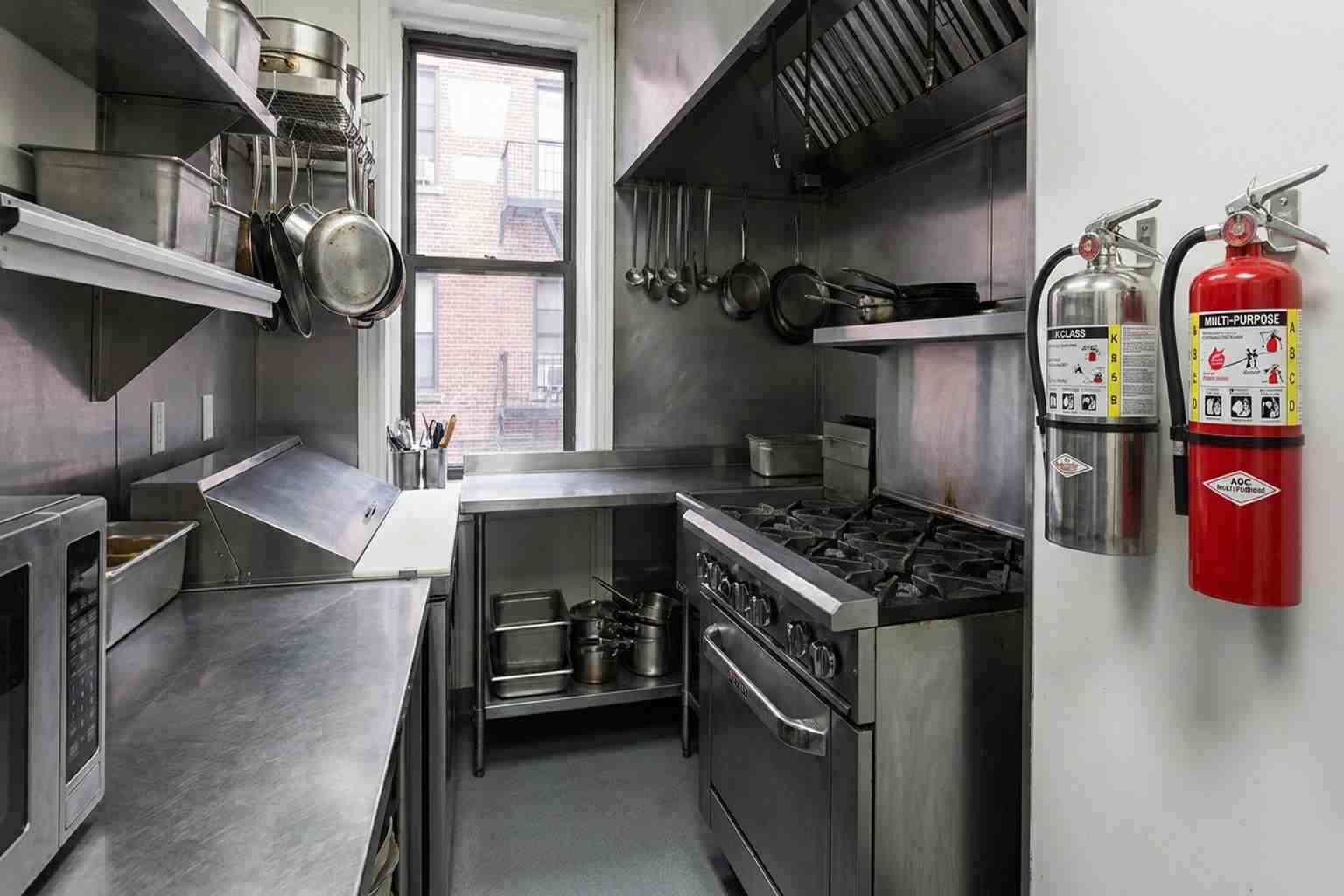
💡 Tip: A mixed ABC fleet plus targeted K and CO2 units near specific hazards beats a single-type fleet of any count. Match the unit to what can actually burn within 30 feet of it.
💡 Tip: A mixed ABC fleet plus targeted K and CO2 units near specific hazards beats a single-type fleet of any count. Match the unit to what can actually burn within 30 feet of it.
Room-by-Room Rules That Add Units
Beyond floor area, specific rooms and features add units no matter what the square footage says.
Kitchens and Break Rooms
Any commercial cooking area needs its own Class K unit, positioned within reach of the hood's fire suppression system. Even a staff break room with a toaster oven needs a unit nearby - these rooms start a disproportionate share of building fires.
Electrical and Mechanical Rooms
Boiler rooms, elevator machine rooms, and electrical closets each need a rated unit at the door. Rooftop mechanical spaces count too.
Per Floor, Stairs, and Egress
NFPA 10 requires at least one unit per floor, even small mezzanines used for storage. Units must sit along normal exit paths - a corridor, not a locked office. If a floor has multiple wings separated by fire doors, each wing needs its own 75-foot coverage.
⚠️ Warning: Units inside rooms that stay locked do not count toward the 75-foot travel path. Mount extinguishers along open exit routes.
| Location | What to Place | Trigger |
|---|---|---|
| Cooking line | K-rated within 30 ft | Commercial fryers or grills |
| Electrical room | CO2 or clean agent | Energized equipment |
| Each floor | Min one 2-A unit | Always, regardless of size |
| Storage areas | Extra hazard rated | Combustible stock |
| Loading dock | 10-B or larger | Vehicle and fuel exposure |
FDNY and NYC Code Angles
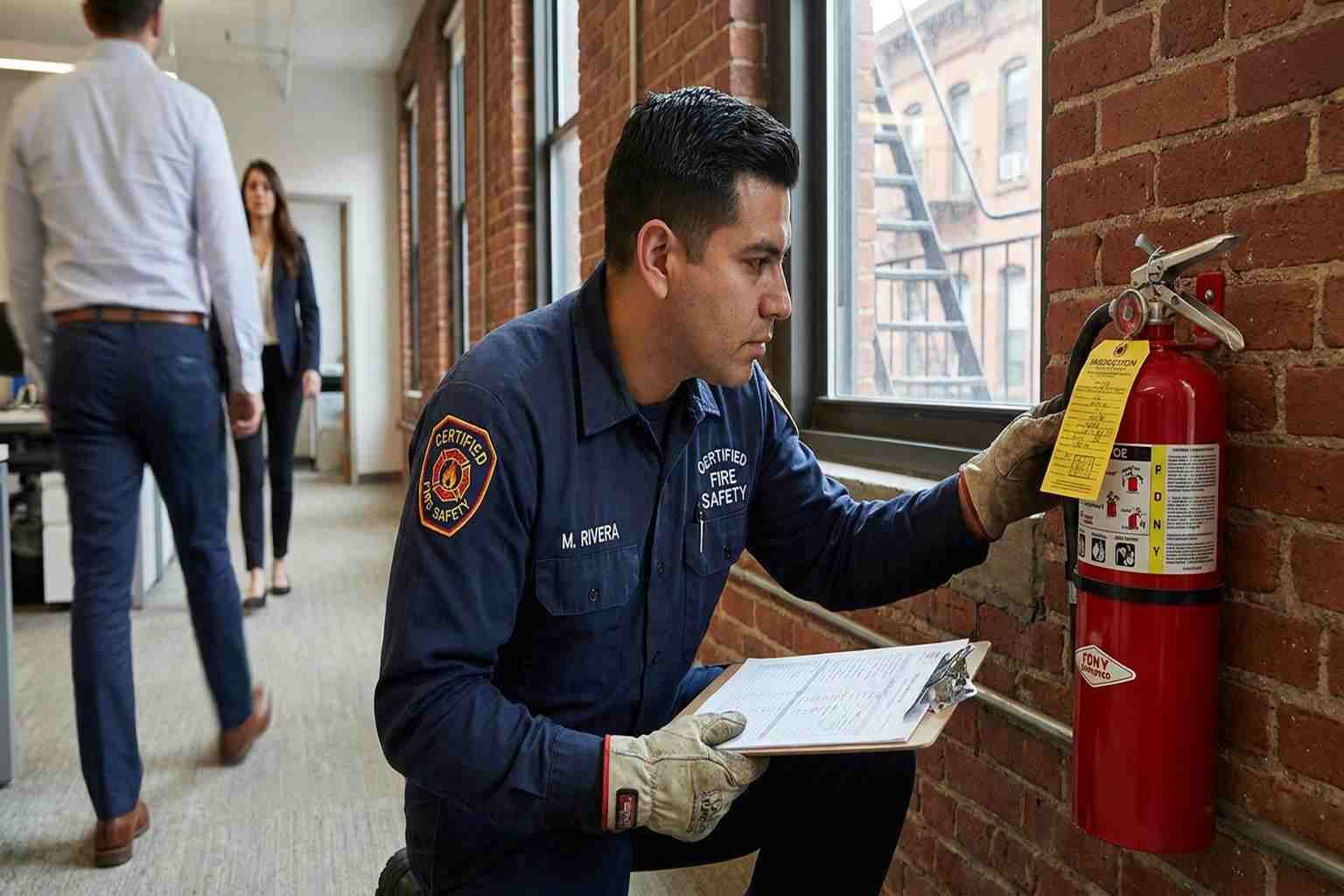
New York City follows NFPA 10 logic but enforces it through FDNY extinguisher inspections - examiners walk buildings with fresh eyes. Expect the inspector to check placement height (3.5 to 5 feet from floor to handle), visibility from the corridor, and a current tag on every cylinder. Extinguisher compliance paperwork travels with the units - missing tags fail an inspection even when placement is perfect.
Annual certification needs a licensed service beyond monthly self-checks. When FDNY flags a placement gap, the fix costs less than the violation - call (718) 852-2762 and a technician can reposition or add units the same week.
Counting Is the Easy Part: Keep Every Unit Compliant
Once the right number of units hang in the right spots, code shifts from geometry to maintenance. Every fire extinguisher needs:
- A monthly visual check - in place, gauge in the green, pin and seal intact, no corrosion
- An annual professional inspection - documented with a dated tag, required for FDNY compliance
- Internal maintenance and hydrostatic testing on a 6-year (stored pressure) and 12-year (cartridge) cycle, or 5-year for CO2 cylinders
- Immediate recharge or replacement after any discharge - a 1-second test squeeze empties enough pressure to fail inspection
Our recharge service refills and recertifies units on site across NYC, so one visit restores the full count instead of leaving a gap while units ship out.
Common Mistakes When Counting Extinguishers
After thousands of Brooklyn inspections, the same shortfalls keep showing up:
- Counting by square footage only and ignoring the 75-foot travel rule around corners and partitions
- Treating the basement as one zone when boiler, storage, and laundry areas each need coverage
- Forgetting mezzanines and rooftops used for storage or mechanical access
- Matching units to hazards by habit - ABC everywhere instead of K-rated or CO2 units where the risk lives