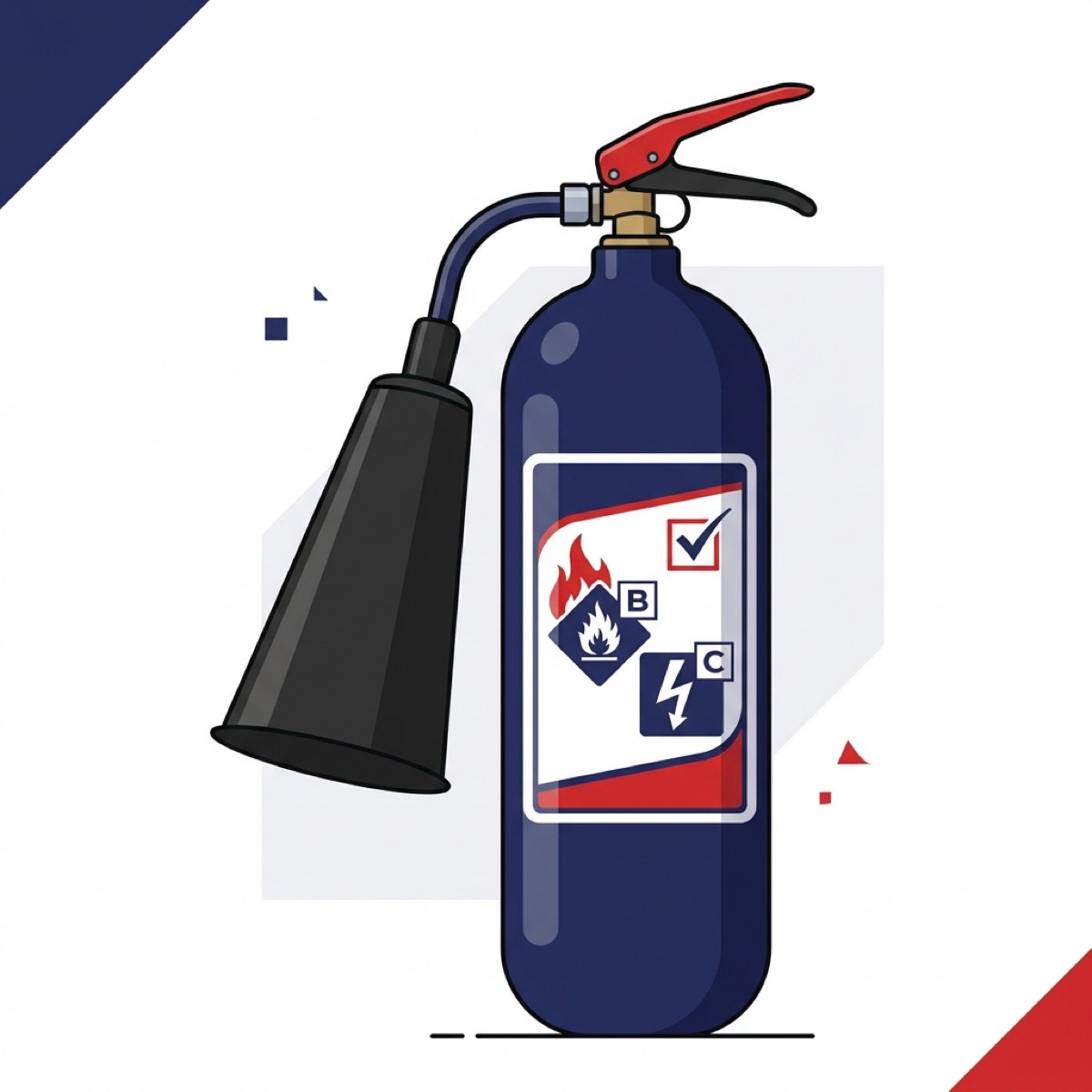
A CO2 fire extinguisher uses compressed carbon dioxide to fight Class B (flammable liquid) and Class C (electrical) fires. Unlike dry chemical extinguishers that leave a messy powder residue, CO2 discharges as a clean gas that evaporates completely - making it the preferred choice for server rooms, laboratories, telecommunications facilities, and any environment with sensitive electronic equipment.
Key Takeaways
- CO2 extinguishers are rated for Class B and C fires only - not Class A combustibles
- Zero residue - CO2 gas evaporates completely, ideal for electronics and sensitive equipment
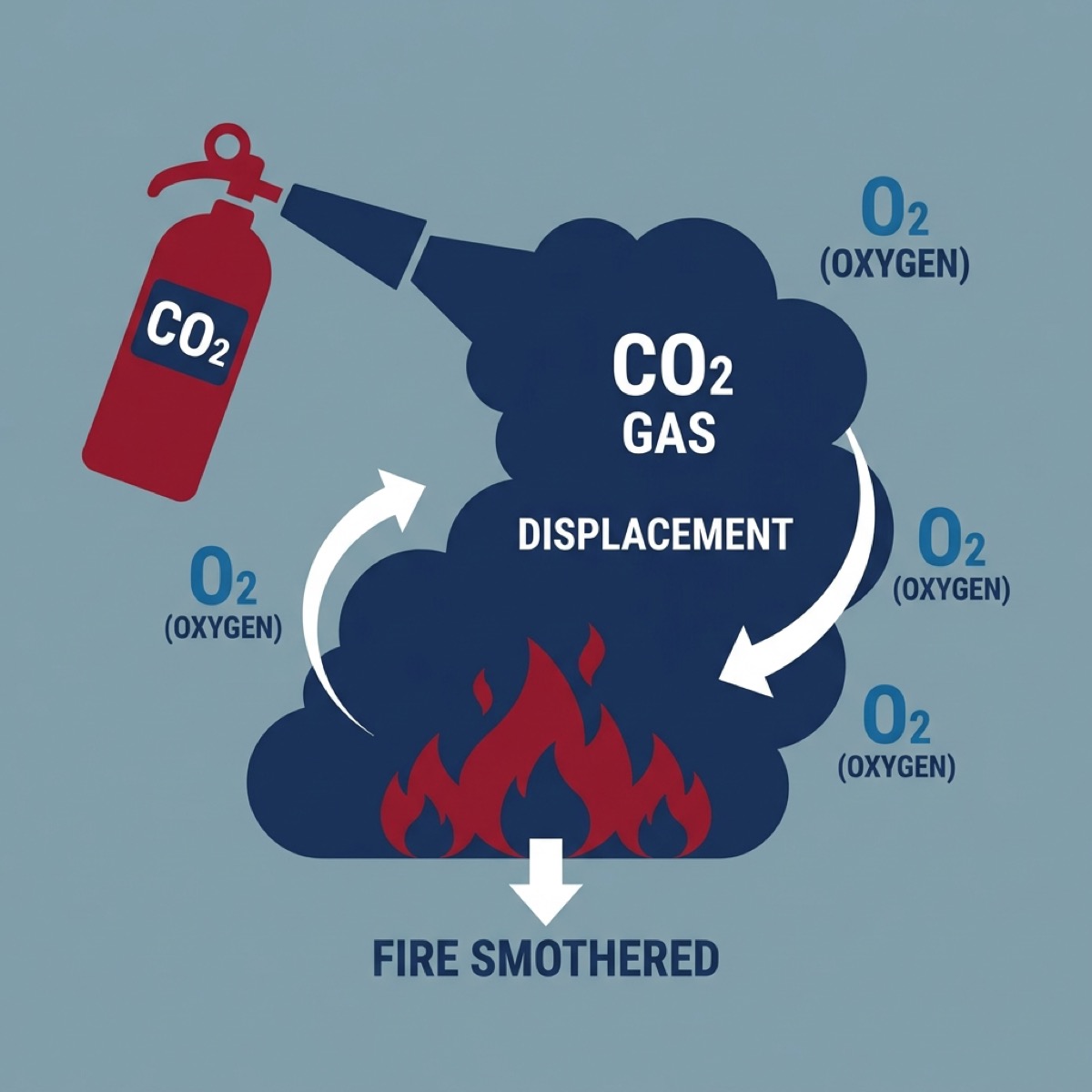
- Works by oxygen displacement - reduces oxygen below the 15% needed for combustion
- Non-conductive - safe for live electrical equipment and wiring
- NFPA 10 requires hydrostatic testing every 5 years - shorter interval than other extinguisher types
What Is a CO2 Fire Extinguisher?
A CO2 fire extinguisher contains liquid carbon dioxide stored under high pressure (approximately 850 psi at room temperature). When the handle is squeezed, the liquid CO2 expands rapidly through the discharge horn, converting to a mixture of gas and dry ice "snow" that smothers the fire by displacing oxygen and cooling the fuel surface.
The key advantage of CO2 is that it leaves no residue whatsoever. After the fire is out, the CO2 dissipates into the atmosphere, leaving equipment, documents, and surfaces completely clean. This is why CO2 extinguishers are standard in environments where dry chemical powder would cause more damage than the fire itself:
- Server rooms and data centers
- Telecommunications switching facilities
- Laboratories with sensitive instruments
- Museums and archives
- Food preparation areas
- Electrical panel rooms and transformer stations
How CO2 Fire Extinguishers Work
CO2 extinguishes fire through two mechanisms:
Oxygen Displacement
Carbon dioxide is heavier than air. When discharged, it blankets the fire area and displaces oxygen, reducing the concentration below the 15% threshold needed for combustion. Without sufficient oxygen, the fire cannot sustain itself.
Cooling Effect
As the liquid CO2 expands to gas, it undergoes a rapid pressure drop that absorbs heat from the surrounding area. The discharge also produces dry ice particles (frozen CO2 at -109.3°F) that provide additional cooling to the fuel surface.
⚠️ Critical Safety Warning: CO2 extinguishers displace oxygen, which means they can create an oxygen-deficient atmosphere in enclosed spaces. Never use a CO2 extinguisher in a small, unventilated room without immediately evacuating after discharge. CO2 concentrations above 7% can cause unconsciousness within minutes.
CO2 Fire Extinguisher Ratings and Classes
CO2 extinguishers carry a Class B:C rating, meaning they are approved for:
| Fire Class | Fuel Type | CO2 Effectiveness |
|---|---|---|
| Class A | Wood, paper, cloth | ❌ Not rated - insufficient cooling to prevent re-ignition |
| Class B | Flammable liquids, gases | ✅ Excellent - oxygen displacement smothers liquid fires |
| Class C | Electrical equipment | ✅ Excellent - non-conductive, zero residue |
| Class D | Combustible metals | ❌ Not rated - can cause chemical reactions |
| Class K | Cooking oils and fats | ❌ Not rated - use wet chemical instead |
Common CO2 extinguisher sizes and their ratings:
- 5 lb CO2 unit: 5B:C rating - suitable for small offices and electrical rooms
- 10 lb CO2 unit: 10B:C rating - standard for server rooms and labs
- 15 lb CO2 unit: 10B:C rating - industrial applications and large electrical facilities
- 20 lb CO2 unit: 10B:C rating - heavy industrial and transformer protection
CO2 vs Dry Chemical Extinguishers
Many facility managers ask whether to install CO2 or ABC dry chemical extinguishers. The answer depends on what you're protecting:
| Feature | CO2 Extinguisher | ABC Dry Chemical |
|---|---|---|
| Class A fires | ❌ No | ✅ Yes |
| Class B fires | ✅ Yes | ✅ Yes |
| Class C (electrical) | ✅ Yes | ✅ Yes |
| Residue | None | Powder residue everywhere |
| Equipment damage | None | Powder can damage electronics |
| Re-ignition risk | Higher (no coating) | Lower (powder coats fuel) |
| Enclosed space risk | Oxygen displacement hazard | None |
💡 Best Practice: Many facilities use both - CO2 units near electronic equipment and ABC dry chemical units for general building protection. This provides complete coverage without sacrificing equipment safety. Consult our fire extinguisher types guide for a complete breakdown.
Where CO2 Fire Extinguishers Are Required
NFPA 10 and local fire codes require CO2 extinguishers in specific settings:
- Server rooms and data centers - dry chemical would destroy servers
- Telecommunications facilities - switching equipment is extremely sensitive to powder
- Electrical panel rooms - CO2 is non-conductive, safe for live equipment
- Laboratories - protects sensitive instruments and experiments
- Museums and art galleries - powder would damage artwork and artifacts
- Food storage areas - no contamination risk from powder
- Marine engine rooms - clean agent preferred for enclosed spaces
- Industrial control rooms - protects PLCs, SCADA, and monitoring equipment
How to Use a CO2 Fire Extinguisher
CO2 extinguishers use the standard PASS method, but with important modifications:
- Pull the safety pin and break the tamper seal
- Aim the horn at the base of the fire - keep hands away from the horn (it gets extremely cold)
- Squeeze the handle to discharge CO2
- Sweep the horn slowly across the base of the fire
⚠️ Frostbite Warning: The CO2 discharge horn can reach temperatures of -110°F during discharge. NEVER touch the horn during or immediately after use. Always hold the extinguisher by the handle only. Severe frostbite can occur within seconds of skin contact with the horn.
Inspection and Maintenance
CO2 extinguishers require the same inspection schedule as other portable extinguishers per NFPA 10, but with a shorter hydrostatic testing interval:
- Monthly visual inspection - verify the extinguisher is in place, the gauge reads in the green zone, the pin and seal are intact, and the discharge horn is undamaged
- Annual professional inspection - certified technician verifies CO2 weight (not just pressure), cylinder condition, horn integrity, and overall functionality
- Hydrostatic testing every 5 years - shorter than the 12-year interval for dry chemical, because CO2 cylinders operate at much higher pressure (850+ psi)
- 12-year cylinder replacement - some jurisdictions require CO2 cylinders to be replaced after 12 years regardless of hydrostatic test results
CO2 extinguishers do not have a traditional pressure gauge like dry chemical units. Instead, they are verified by weighing the cylinder and comparing to the full weight stamped on the label. If the weight has dropped more than 10%, the extinguisher must be recharged. For professional fire extinguisher inspections in NYC, A&J Fire provides certified CO2 maintenance services.
CO2 Fire Extinguisher Cost
CO2 extinguishers are moderately more expensive than dry chemical units:
- 5 lb CO2 unit: $180-$280
- 10 lb CO2 unit: $250-$400
- 15 lb CO2 unit: $350-$500
- 20 lb CO2 unit: $450-$650
Recharge costs are typically $40-$80 depending on size. While the initial investment is higher than ABC dry chemical, the protection of expensive electronic equipment justifies the cost. One CO2 extinguisher can save thousands in equipment damage that dry chemical powder would cause.