Key Takeaways
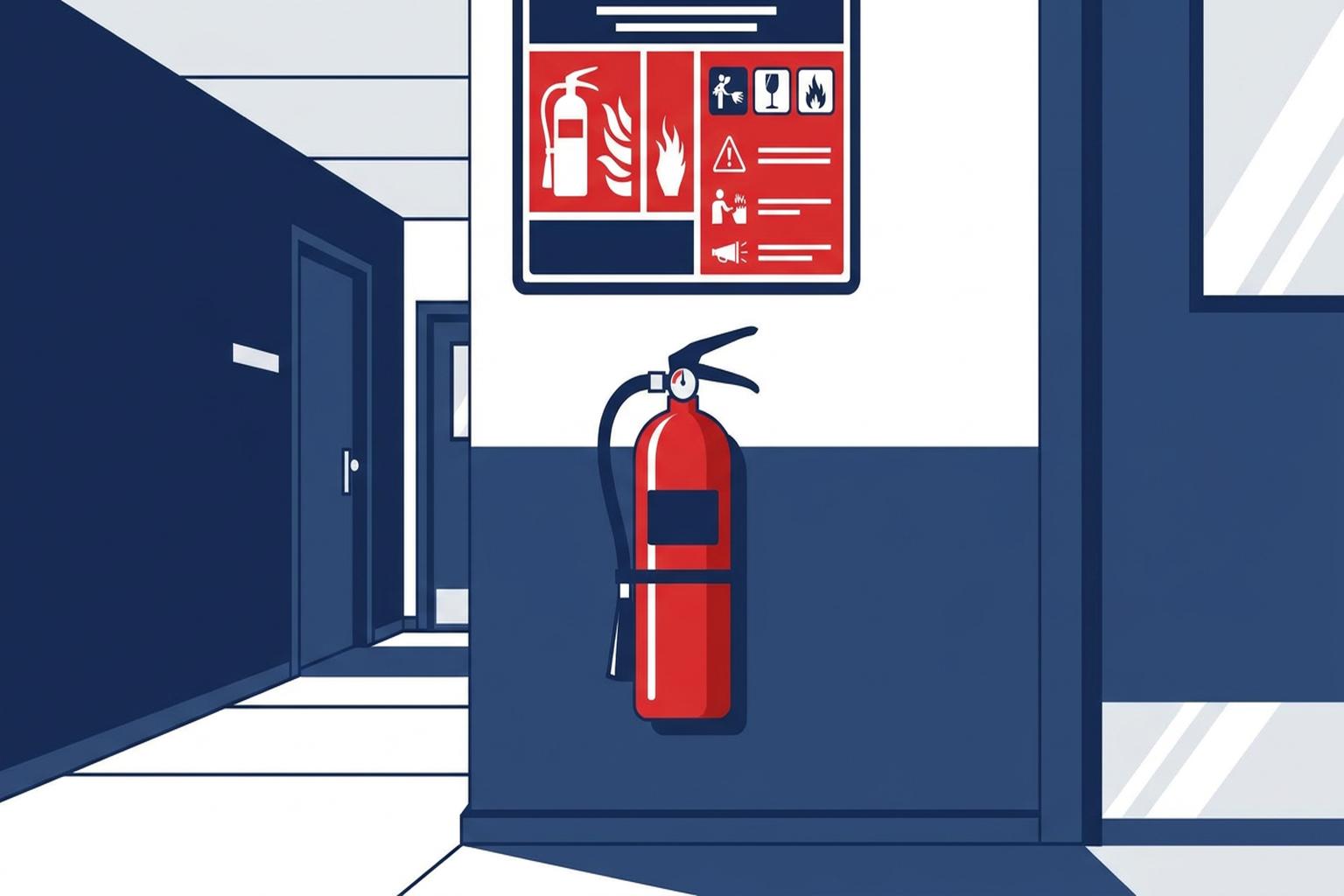
Every business in Brooklyn needs to understand OSHA fire extinguisher requirements to keep employees safe and avoid costly citations. At A&J Fire, we have helped New York City businesses meet OSHA and FDNY fire safety standards for over three decades. Whether you run a restaurant in Williamsburg, a warehouse in Red Hook, or an office building in downtown Brooklyn, the federal rules apply to your workplace.
OSHA standard 29 CFR 1910.157 governs portable fire extinguisher requirements in general industry. The regulation covers placement, mounting, selection, inspection, maintenance, and employee training. Business owners who skip these requirements face fines up to $15,625 per violation. This guide breaks down every requirement in plain language so you can assess your building with confidence.
What Are OSHA Fire Extinguisher Requirements?
OSHA fire extinguisher requirements come from 29 CFR 1910.157, the federal standard for portable fire extinguishers in the workplace. The rule applies to nearly every employer in the United States. If you provide extinguishers for employee use, you must follow the full standard.
The core obligation is straightforward: employers must provide portable fire extinguishers and mount, locate, and identify them so they are readily accessible to employees without subjecting those employees to possible injury. Extinguishers cannot be locked in a closet, hidden behind storage, or placed where someone must climb over machinery to reach one.
OSHA breaks the standard into several parts: general requirements, selection and distribution, inspection and maintenance, hydrostatic testing, and training. Each has specific rules business owners must follow.
OSHA Standard 1910.157: The Core Regulation
The full name is 29 CFR 1910.157, part of OSHA's general industry standards. It covers portable fire extinguisher placement, use, maintenance, and testing. The standard applies to all employers who provide extinguishers for employee use, even if local fire codes do not specifically require them.
One exemption exists: if an employer has a written emergency action plan and fire prevention plan meeting 29 CFR 1910.38, and employees are instructed to evacuate rather than fight fires, only the inspection, maintenance, and hydrostatic testing sections apply. In practice, most NYC businesses keep extinguishers for employee use, so the full standard applies.
The standard references NFPA 10, the National Fire Protection Association's portable extinguisher standard. OSHA has adopted portions by reference, so following NFPA 10 helps ensure compliance. Our team at A&J Fire follows both OSHA and NFPA 10 standards during every fire extinguisher inspection.
Fire Extinguisher Placement and Mounting Requirements
OSHA has specific rules for how extinguishers must be mounted and where they can be placed. These rules ensure anyone can find and grab an extinguisher within seconds during an emergency.
Mounting Height
The OSHA mounting height requirements are:
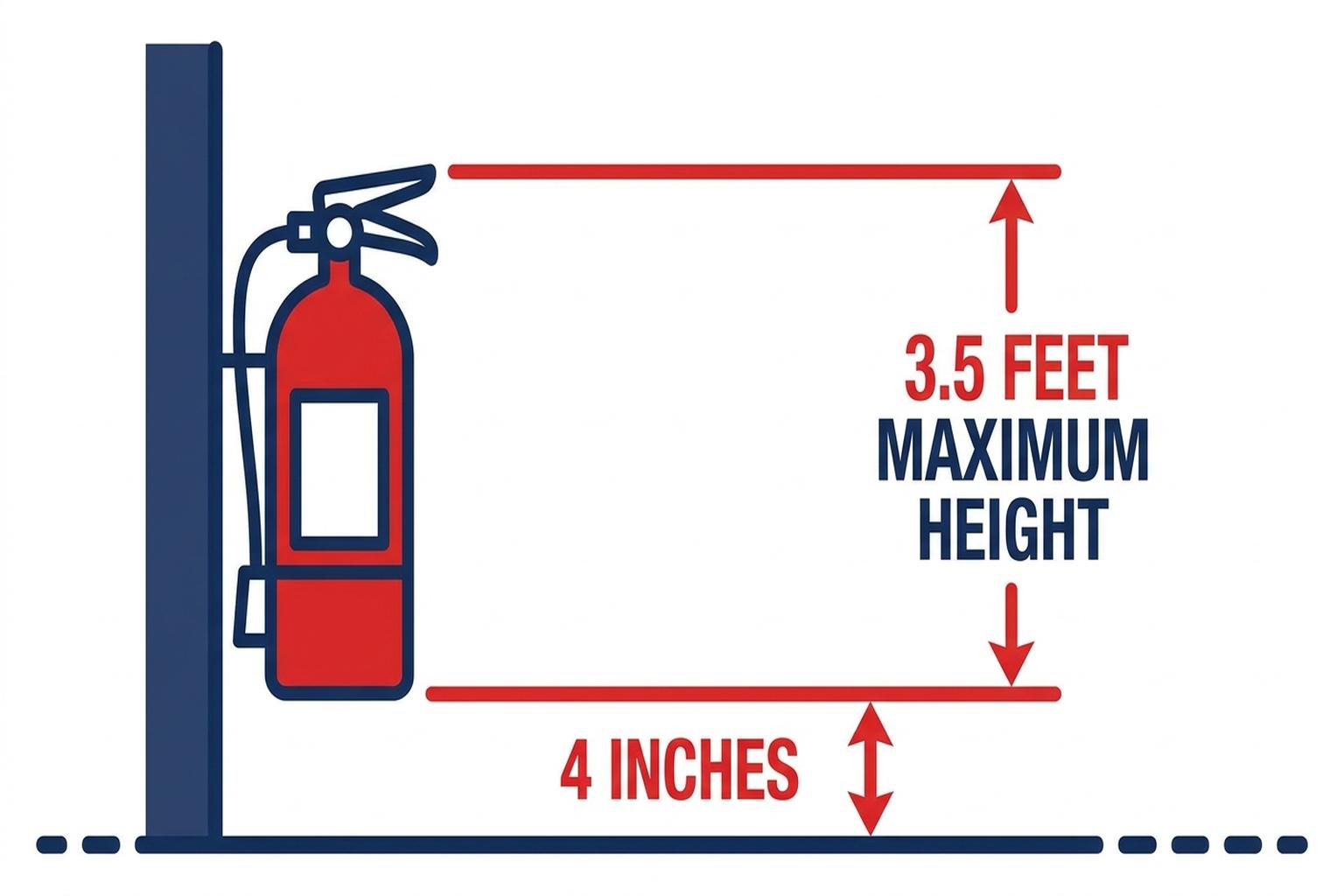
- The bottom of a portable fire extinguisher must be at least 4 inches above the floor
- For extinguishers weighing 40 pounds or less, the top of the unit cannot be more than 3.5 feet from the floor
- For extinguishers weighing more than 40 pounds, the top cannot be more than 3 feet from the floor
These height rules ensure extinguishers are high enough to avoid floor moisture but low enough for most people to reach and remove from their bracket.
Placement Location
Extinguishers must be placed where they are readily accessible. OSHA defines this as available for immediate use:
- Not behind locked doors or in restricted areas
- Not blocked by equipment, boxes, or furniture
- Identified with signs so employees can locate them quickly
- Mounted on brackets or in cabinets designed for fire extinguisher storage
If an extinguisher is in a cabinet, the cabinet must have a sign or marking identifying it. Our OSHA-compliant signage solutions help Brooklyn businesses stay visible and compliant.
OSHA Travel Distance Requirements
One of the most common OSHA violations involves travel distance. OSHA sets maximum travel distances based on the fire hazard class:
- Class A hazards: Extinguishers must be within 75 feet of travel distance from any point in the work area
- Class B hazards: Extinguishers must be within 50 feet of travel distance
- Class C hazards: Travel distance is based on the underlying Class A or B hazard
Travel distance means the actual path an employee would walk, not a straight line. If your warehouse has aisles and shelving that require a winding path, you measure along that path. In NYC's narrow commercial spaces, this can mean you need more extinguishers than you might expect.
For large facilities, a professional fire safety assessment is the best way to confirm you meet travel distance requirements. Our inspection service includes a full travel distance audit for your building.

Fire Extinguisher Classes and Selection
OSHA requires employers to select the correct extinguisher type based on workplace hazards. Using the wrong type can be dangerous and ineffective.
The Five Fire Classes
| Fire Class | Hazard Type | Typical Location | Required Extinguisher |
|---|---|---|---|
| Class A | Wood, paper, cloth, ordinary combustibles | Offices, retail, warehouses | Water, foam, or ABC dry chemical |
| Class B | Flammable liquids, gases, oils | Garages, kitchens, industrial | CO2, BC dry chemical, or foam |
| Class C | Electrical equipment | Server rooms, electrical panels | CO2 or clean agent |
| Class D | Combustible metals | Machine shops, labs | Special dry powder agent |
| Class K | Cooking oils and fats | Commercial kitchens | Wet chemical (K-rated) |
OSHA 1910.157(d) requires employers to distribute portable fire extinguishers in the quantity and type needed for the specific hazards. A restaurant kitchen needs Class K extinguishers near cooking equipment. An office building primarily needs Class ABC units in hallways and common areas.
For Brooklyn restaurants and commercial kitchens, a kitchen fire extinguisher rated Class K is required by both OSHA and FDNY. These units are specifically designed for cooking oil fires and are mandatory in any commercial kitchen with deep fryers or griddles.
Inspection and Maintenance Requirements
OSHA requires two levels of inspection for portable fire extinguishers:
Monthly Visual Inspection
Every extinguisher must be visually inspected at least once per month. This check can be done by a designated employee and should verify:
- It is visible and accessible (not blocked)
- The pressure gauge reads in the operable range
- The safety seal and tamper indicator are intact
- No physical damage, corrosion, or leakage is visible
- Operating instructions are legible
Annual Maintenance
A more thorough maintenance check must be performed annually by a qualified professional, including:
- Internal examination of the extinguisher
- Verification of the extinguishing agent and pressure
- Checking the hose and nozzle for blockages
- Weighing the unit to confirm it is full
- Recording the maintenance date on the inspection tag
Our inspection services cover both monthly and annual requirements with documentation that satisfies OSHA and FDNY inspectors.
Hydrostatic Testing
OSHA also requires periodic hydrostatic testing of extinguisher cylinders. The interval depends on type:
- Dry chemical and halon units: every 5 years
- CO2 and water units: every 5 years
- Welded steel shell: every 5 years
Employee Training Requirements
If employees are expected to use fire extinguishers, OSHA requires training:
- Training must be provided initially upon hiring
- Training must be repeated annually
- Training must include hands-on practice with extinguishers
Classroom-only training does not satisfy OSHA. Employees must physically handle an extinguisher and practice the PASS method (Pull, Aim, Squeeze, Sweep) during training.
If an employer decides employees should not use extinguishers and will only evacuate, a written emergency action plan meeting 29 CFR 1910.38 is required. In that case, fire extinguisher training is not required, but evacuation training is.
For NYC businesses, we recommend training employees regardless. In a city where fire response times can vary, having staff who can use a portable extinguisher in the first 60 seconds can prevent a small fire from becoming a major loss.
OSHA Signage Requirements
OSHA requires that fire extinguishers be identified so employees can locate them. This means:
- Extinguishers must have signage or markings indicating their location
- In areas where visibility is limited, additional signs directing employees to the extinguisher are needed
- Signs must be visible from the normal path of travel
- Red is the standard color for fire equipment signage, making extinguisher locations immediately recognizable
If an extinguisher is in a cabinet, the cabinet must have a sign. If it is on a wall bracket, a sign above the unit is recommended. Proper fire safety signage is one of the simplest compliance steps a business can take, yet it is frequently overlooked during OSHA inspections.
FDNY and NYC Fire Code Considerations
OSHA sets the federal baseline, but NYC adds its own requirements through the FDNY Fire Code. Brooklyn businesses must comply with both.
Key FDNY additions:
- FDNY permits are required for certain fire protection systems and extinguisher installations
- Certificate of Fitness holders may be required for buildings with specific fire protection systems
- FDNY inspections can occur without notice, and violations carry separate fines from OSHA
- Commercial kitchens must have Class K extinguishers that meet FDNY standards, which align with but sometimes exceed NFPA 10
A business can pass an OSHA inspection but fail an FDNY inspection. Working with a fire safety company that understands both sets of regulations is essential. At A&J Fire, we have navigated both OSHA and FDNY requirements for Brooklyn businesses since 1978. Call us at (718) 852-2762 to schedule a compliance assessment.
Common OSHA Violations and Penalties
OSHA citations for fire extinguisher violations are common. The most frequent violations include:
- Blocked access - Extinguishers hidden behind boxes or equipment
- Missing monthly inspections - No record of visual checks
- Expired annual maintenance - Inspection tag is out of date
- Wrong extinguisher type - Using a Class A unit in a kitchen that needs Class K
- No training - Employees expected to use extinguishers but never trained
- Excessive travel distance - Nearest extinguisher is too far from work areas
Penalty Amounts
As of 2026, OSHA penalty amounts are:
- Other-than-serious violation: up to $7,812 per violation
- Serious violation: up to $15,625 per violation
- Willful or repeated violation: up to $156,250 per violation
A single missing inspection tag or blocked extinguisher can result in a serious violation citation. For businesses with multiple locations or multiple extinguishers, penalties multiply quickly. Call A&J Fire at (718) 852-2762 to make sure your business is fully compliant before an inspector arrives.