Most people don't think about how to dispose of a fire extinguisher until they're holding an expired unit and staring at the garbage can. Here's the problem: fire extinguishers are pressurized steel cylinders that can explode in garbage trucks, and their chemical agents may be classified as hazardous waste. Tossing one in the trash isn't just irresponsible - in most cities, including New York, it's illegal and carries fines.
This guide covers every safe and legal way to get rid of an old, expired, or damaged fire extinguisher, whether you're a homeowner, building manager, or business owner in Brooklyn or anywhere in the United States.
Key Takeaways
- Never throw a fire extinguisher in the trash - pressurized cylinders can explode in garbage trucks
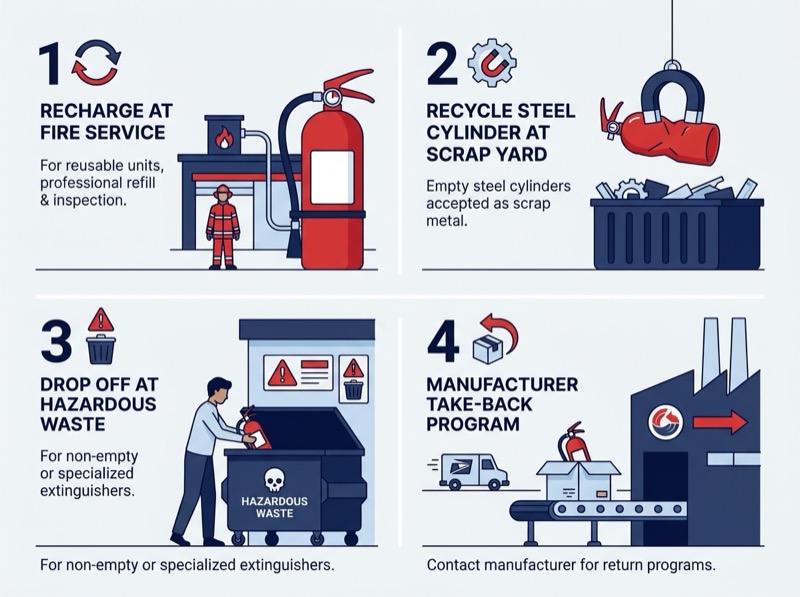
- 4 disposal options: recharge, recycle, hazardous waste drop-off, or manufacturer take-back
- Check the gauge first - expired vs empty determines your disposal path
- NYC residents can use SAFE Disposal Events for free drop-off
- Recharge if under 10 years, replace if over 12 - it's that simple
Why You Can't Just Throw It Away
Fire extinguishers are pressurized vessels - typically charged to 100–195 PSI depending on the type. When crushed in a garbage truck compactor, that pressure can cause the cylinder to rupture violently, sending metal fragments and chemical agent flying. Sanitation workers have been injured by exploding extinguishers in trash trucks.
Beyond the explosion hazard, there are environmental and legal reasons:
- Chemical agents - dry chemical powder (monoammonium phosphate) and wet chemical solution (potassium acetate) can contaminate soil and groundwater in landfills
- Halon and clean agents - older extinguishers may contain halon gas, an ozone-depleting substance regulated under the Clean Air Act
- Recyclable materials - the steel or aluminum cylinder is fully recyclable, keeping valuable metal out of landfills
- Local laws - NYC, California, and many other jurisdictions explicitly ban pressurized cylinders and hazardous chemicals from regular waste streams
⚠️ NYC Fine Warning: The NYC Department of Sanitation issues fines starting at $100 for improper disposal of hazardous materials, including pressurized fire extinguishers. Commercial buildings face fines of $200–$400 per violation under the NYC Commercial Waste Zone rules.
Step 1: Check the Condition - Recharge or Dispose?
Before disposing of an extinguisher, determine whether it can be recharged instead. Recharging is cheaper and more environmentally friendly than replacing - and many "dead" extinguishers just need fresh pressure and agent.
| Condition | Action | Typical Cost |
|---|---|---|
| Gauge in red zone, under 10 years old | Recharge | $15–$40 |
| Partially discharged, still within test date | Recharge | $15–$40 |
| Over 12 years from manufacture date | Replace & recycle | $35–$100+ |
| Visible corrosion, dents, or damage | Replace & recycle | $35–$100+ |
| Failed hydrostatic test | Replace & recycle | N/A - must dispose |
| Halon or clean agent unit | Reclaim agent, recycle cylinder | $50–$100 |
How to Check the Extinguisher Age
Look for the manufacture date stamped on the UL label or the cylinder itself. It's usually a year like "2014" or a month-year code like "06-14". If you can't find a date, check the expiration guide. As a rule:
- Under 10 years: Good candidate for recharging if the cylinder is in good condition
- 10–12 years: Needs hydrostatic testing before recharging; often cheaper to replace
- Over 12 years: Must be retired - replace and recycle the old unit
Step 2: Fully Discharge the Extinguisher (If Disposing)
If you've determined the extinguisher needs to be disposed of (not recharged), you must fully discharge it before recycling or disposal. This removes the pressure that makes the cylinder dangerous.
- Take the extinguisher outside to an open area away from people, vehicles, and storm drains
- Remove the safety pin from the handle
- Aim the nozzle at the ground (not at anyone) and squeeze the handle fully
- Hold until the discharge stops and no pressure remains
- Shake the cylinder - if you hear liquid or feel weight, continue discharging
⚠️ Important: For CO₂ extinguishers (identified by the horn-shaped nozzle and lack of pressure gauge), discharge outdoors in a well-ventilated area. CO₂ can cause frostbite on skin contact and displaces oxygen in enclosed spaces. Never discharge a CO₂ extinguisher indoors.
Step 3: Choose a Disposal Method
Once the extinguisher is fully discharged, you have four options for proper disposal:
Option 1: Recycle the Steel Cylinder
The most common and environmentally responsible method. Most fire extinguishers are steel or aluminum - both highly recyclable materials. Call your local scrap metal facility or recycling center to confirm they accept fire extinguisher cylinders. Many require the valve head to be removed first (use a pipe wrench after full discharge).
Option 2: Household Hazardous Waste Drop-Off
Most county and city governments host hazardous waste collection days where residents can drop off fire extinguishers and other dangerous items for free. These events are typically held monthly or quarterly. Check your local government website for the schedule.
Option 3: Fire Safety Company Take-Back
Companies like A&J Fire Extinguisher accept old fire extinguishers for proper disposal or recycling. This is the fastest and most convenient option for NYC-area residents and businesses. We handle the discharge, agent disposal, and cylinder recycling - you just drop it off.
Option 4: Manufacturer Take-Back Program
Some fire extinguisher manufacturers (including Amerex and Kidde) offer take-back programs where they accept their own branded units for recycling. Contact the manufacturer directly to see if they offer this service. It's less common for consumer-grade extinguishers but available for commercial units.
NYC-Specific Disposal Rules
New York City has specific regulations for fire extinguisher disposal that differ from many other areas:
- NYC SAFE Disposal Events: The Department of Sanitation (DSNY) hosts free SAFE (Solvents, Automotive, Flammables, Electronics) disposal events throughout the five boroughs. Fire extinguishers are accepted at all SAFE events. Check the DSNY website for upcoming dates and locations.
- Drop-off facilities: The DSNY Special Waste Drop-Off Site in Brooklyn (Bay 41st Street) accepts fire extinguishers on Saturdays by appointment
- Commercial buildings: NYC building owners must use licensed commercial waste haulers for fire extinguisher disposal - residential drop-off events are not for commercial quantities
- Co-op and condo buildings: Building managers should arrange bulk disposal through a fire safety company rather than relying on individual residents to dispose of units
💡 Brooklyn Residents: A&J Fire Extinguisher at 265 Livingston St accepts old fire extinguishers for proper recycling during business hours. No appointment needed for residential drop-off - just bring the extinguisher with the pin still in place.
Disposal by Extinguisher Type
Different extinguisher types have different disposal requirements based on the agent they contain:
| Type | Agent | Disposal Notes |
|---|---|---|
| ABC Dry Chemical | Monoammonium phosphate | Discharge fully, recycle cylinder. Agent is not highly toxic but irritant. |
| BC Dry Chemical | Sodium bicarbonate | Same as ABC. Agent is essentially baking soda - low toxicity. |
| CO₂ | Carbon dioxide (liquid) | Discharge outdoors. No chemical waste. Cylinder recyclable after valve removal. |
| Wet Chemical (Class K) | Potassium acetate solution | Agent is water-soluble but should go to hazardous waste. Don't dump in drains. |
| Clean Agent (Halon) | Halon 1301 or 1211 | ⚠️ Ozone-depleting substance. Must be reclaimed by certified handler. DO NOT discharge. |
| Clean Agent (Halotron) | HCFC blend | Reclaim at certified facility. Less harmful than Halon but still regulated. |
What Not to Do
- Don't throw it in the trash. Pressurized cylinders are dangerous in waste processing equipment and illegal to dispose of in regular waste streams in most areas.
- Don't puncture the cylinder. Even "empty" extinguishers can retain pressure. Puncturing can cause the cylinder to rocket or shatter. Always discharge through the valve first.
- Don't pour agents down the drain. Wet chemical and some dry chemical agents can contaminate water systems. Monoammonium phosphate is particularly harmful to aquatic life.
- Don't burn fire extinguishers. The chemicals inside create toxic fumes when burned, and the pressurized cylinder is an explosion hazard near heat sources.
- Don't abandon them. Leaving extinguishers at the curb or in public spaces creates a hazard and may result in fines.
Recharge vs Replace: When Each Makes Sense
If your extinguisher still has life left, recharging is almost always the better choice. Here's when to choose each:
Recharge When:
- The extinguisher is under 10 years old
- The cylinder has no visible corrosion, dents, or damage
- The hydrostatic test date is current (or not yet due)
- Only the pressure is low - the agent is still present
- The unit was partially discharged (used for a small fire or accidentally triggered)
Replace When:
- The manufacture date is over 12 years ago
- Visible corrosion, rust, dents, or weld damage on the cylinder
- The extinguisher has failed an inspection or hydrostatic test
- It's a disposable (non-rechargeable) model - these cannot be serviced
- The cost of recharging plus inspection approaches the cost of a new unit
For NYC businesses and building owners, A&J Fire Extinguisher provides same-day recharging services with FDNY-certified tags. Call (718) 852-2762 to schedule a recharge or disposal pickup. The most eco-friendly option is fire extinguisher recycling, which safely recovers the pressurized contents and metal shell. Knowing your extinguisher's shelf life helps you plan for proper disposal before it becomes unsafe. After disposing of an old unit, fire extinguisher replacement ensures you stay protected and code-compliant.