🔑 Key Takeaways
- Fire extinguishers do expire - most dry chemical units have a 12-year maximum service life
- Check the manufacture date stamped on the bottom or printed on the label to determine age
- Monthly visual inspections are required by NFPA 10 - check the pressure gauge, safety pin, and condition
- Professional annual inspections are mandatory for businesses - A&J Fire provides FDNY-certified inspections throughout NYC
- Replace immediately if the gauge reads low, the pin is missing, or there's visible damage or corrosion
If you're wondering about the fire extinguisher shelf life in your office, building, or home, you're asking the right question. An expired or compromised fire extinguisher won't protect you when you need it - and in New York City, it won't satisfy the fire department either.
The truth is, most people install a fire extinguisher and forget about it. Years pass. The pressure bleeds out. The powder settles and compacts. The tamper seal falls off. And when a fire breaks out, that extinguisher on the wall might give you nothing - or worse, a false sense of security.
This guide covers exactly how long fire extinguishers last, how to read expiration dates, what NFPA 10 requires for inspections, and when to replace your unit - whether you're a building owner, facility manager, or homeowner in Brooklyn, Queens, Manhattan, or anywhere in the NYC metro area.
Do Fire Extinguishers Expire?
Yes, fire extinguishers do expire - but not in the way most people think. There's no single "expiration date" printed on the cylinder. Instead, the shelf life of a fire extinguisher depends on the type, maintenance history, and service records.
Here's what actually determines when your extinguisher expires:
- Manufacture date - Every extinguisher is stamped with a manufacturing date. For dry chemical units, the maximum service life is 12 years from this date without hydrostatic testing.
- Pressure loss - If the gauge needle drops below the green zone, the extinguisher has lost pressure and may not discharge properly. This can happen at any age.
- Physical damage - Dents, rust, corrosion, or cracked hose assemblies mean the unit should be replaced - regardless of its age.
- Missing safety pin or tamper seal - If the pin or seal is gone, the extinguisher may have been partially discharged. It needs professional inspection before being returned to service.
📋 Where to Find the Manufacture Date
Look at the bottom of the cylinder for a stamped date (e.g., "05 2020" means May 2020). Some units print the date on the label. If you see just a year (like "2018"), that's the manufacture year. Count forward 12 years - if it's 2018, the unit expires in 2030 without hydrostatic testing.
Fire Extinguisher Lifespan by Type
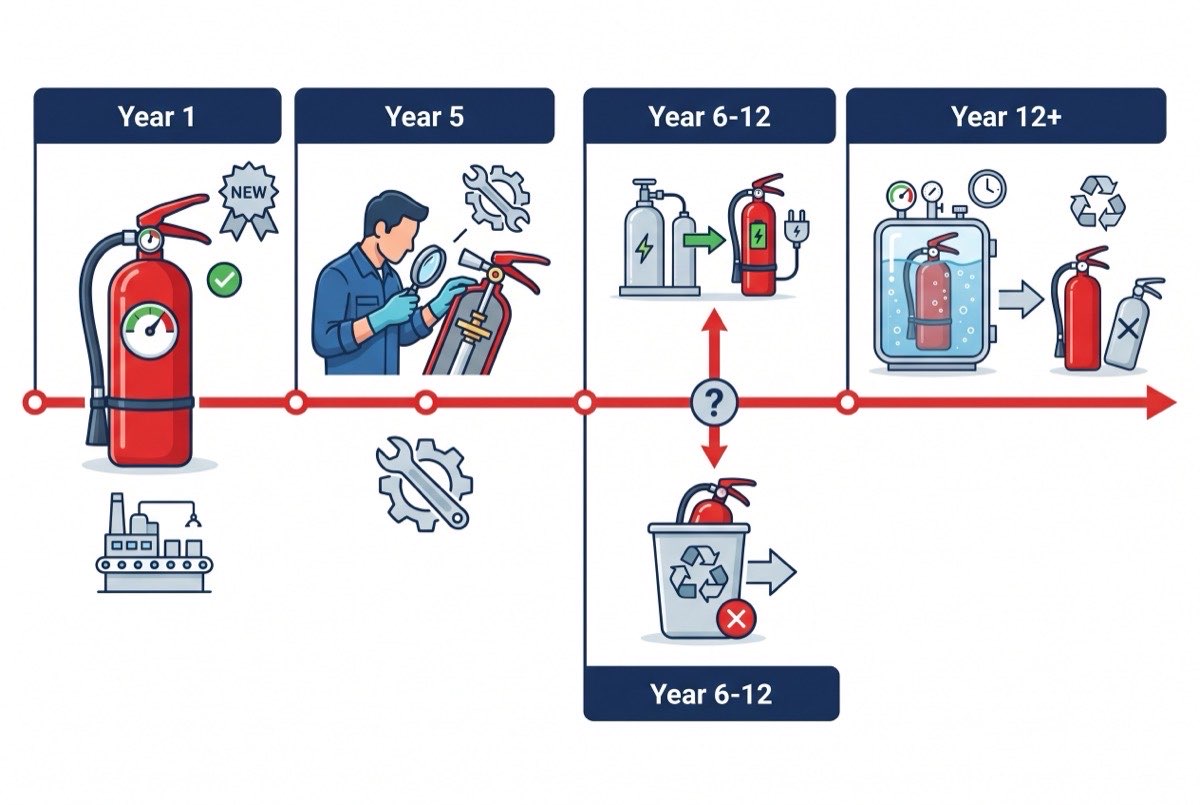
Not all fire extinguishers have the same shelf life. The type of extinguishing agent determines how long the unit lasts and what maintenance it requires:
| Extinguisher Type | Typical Lifespan | Hydro Test Interval | Key Limitation |
|---|---|---|---|
| Dry Chemical (ABC/BC) | 5–12 years | Every 12 years | Powder compacts over time; shake monthly |
| CO2 | 5–15+ years | Every 5 years | No pressure gauge; weigh to check |
| Water / Foam | 5 years | Every 5 years | Freezes in cold temperatures |
| Clean Agent (Halotron) | 5–12 years | Every 12 years | Higher cost; check gauge monthly |
| Wet Chemical (Class K) | 5 years | Every 5 years | For commercial kitchens; requires annual pro inspection |
| Disposable (one-time use) | 10–12 years | Cannot be tested | Must be replaced after use or expiration |
⚠️ Disposable vs. Rechargeable
Disposable fire extinguishers (often sold at big-box stores for $15–$30) cannot be recharged or hydrostatically tested. Once they reach 12 years from the manufacture date - or are discharged even partially - they must be replaced entirely. Rechargeable units cost more upfront but can be serviced and tested for decades, making them the better long-term investment for businesses.
NFPA 10 Inspection Requirements
NFPA 10 (Standard for Portable Fire Extinguishers) sets the inspection schedule that virtually every fire code in the country references, including New York City's FDNY regulations:
Monthly Visual Inspection (Owner/Operator Responsibility)
Every month, walk past each extinguisher and confirm:
- Pressure gauge is in the green zone - not too high, not too low
- Safety pin and tamper seal are intact - if missing, the unit may have been used
- No visible damage - dents, rust, corrosion, cracked hoses, blocked nozzles
- Shake dry chemical units - prevents the powder from compacting at the bottom
- Proper mounting - still secured in its bracket, not buried behind storage
Annual Professional Inspection (Certified Technician)
Once a year, a certified fire equipment technician must perform a thorough inspection that includes:
- Verifying the correct type and placement for the hazard
- Weighing the unit to confirm full charge
- Checking internal condition (for rechargeable units)
- Verifying hose and nozzle are clear and functional
- Documenting the inspection with a dated tag or record
In New York City, FDNY-certified inspections are mandatory for commercial buildings, and the FDNY conducts random spot checks. Failing an inspection means fines and potential closure orders. A&J Fire Extinguisher provides these annual inspections throughout Brooklyn, Queens, Manhattan, the Bronx, Staten Island, Long Island, and New Jersey.
When to Replace Your Fire Extinguisher
Replace your fire extinguisher immediately if any of these conditions apply:
- Gauge reading is low or in the red zone - the unit has lost pressure and may not discharge
- Older than 12 years from manufacture date (dry chemical) - must be hydrostatically tested or replaced
- Visible dents, rust, or corrosion - structural integrity is compromised
- Safety pin or tamper seal is missing - may have been partially discharged
- Hose or nozzle is cracked, blocked, or deteriorated - agent won't reach the fire
- It has been discharged - even a brief burst empties the unit; it must be recharged or replaced
- Disposable unit past its date - cannot be serviced; must be replaced entirely
💡 How to Dispose of an Expired Fire Extinguisher
Never throw a pressurized extinguisher in the trash - it's a compressed gas cylinder and can be dangerous. Options: 1) Bring it to a household hazardous waste drop-off (NYC offers free SAFE Disposal events), 2) Take it to a fire extinguisher service company like A&J for proper depressurization and recycling, or 3) If fully discharged and depressurized, the metal cylinder can be recycled as scrap metal after removing the valve head.
Consequences of Using an Expired Fire Extinguisher
Using an expired or compromised fire extinguisher carries serious risks:
- It may not work - The most obvious risk. A low-pressure unit might not discharge at all, or only partially, leaving you defenseless against a fire.
- OSHA violations - Businesses are required to maintain functional, inspected extinguishers. An expired unit is an OSHA violation with fines from $15,625 per violation.
- NFPA and local fire code violations - NYC FDNY inspectors will cite expired extinguishers immediately. Fines start at $1,000 and increase for repeat violations.
- Insurance claim denial - After a fire, if your insurance adjuster finds expired or uninspected extinguishers, they may deny your claim for failure to maintain fire safety equipment.
- Liability risk - In a lawsuit following a fire injury, opposing counsel will check your extinguisher maintenance records. Expired units = negligence.
⚠️ The Bottom Line
An expired fire extinguisher isn't just useless - it's dangerous. It gives a false sense of security, violates fire codes, and can cost you tens of thousands in fines, denied insurance claims, and liability. If you're unsure about the age or condition of your extinguishers, schedule a professional inspection today.
Professional Fire Extinguisher Inspection Services from A&J Fire
For building owners, facility managers, and businesses in the New York City metro area, A&J Fire Extinguisher provides complete fire safety services:
- FDNY-certified annual inspections - Fully documented inspections that satisfy NFPA 10, OSHA, and FDNY requirements
- Recharging and hydrostatic testing - Extend the life of your rechargeable extinguishers with professional servicing
- Expiration date audits - We check every unit in your building, identify expired extinguishers, and replace them on the spot
- Monthly inspection programs - Scheduled walkthroughs so you never miss an inspection
- New unit sales and installation - ABC, BC, CO2, clean agent, and Class K units rated for your specific hazards
Don't wait for an FDNY inspection to find out your extinguishers are expired. We've been protecting New Yorkers since 1965 - book an inspection or call us directly.
Our team at A&J Fire provides fire extinguisher inspections, recharge services, and recycling services across all five NYC boroughs. Learn more about proper disposal methods when your extinguisher expires. Call (718) 852-2762 to schedule service. If you're wondering how long fire extinguishers last, most need replacement every 5-15 years depending on type. When your extinguisher reaches the end of its shelf life, fire extinguisher replacement is the safest option. Regular inspections help track remaining shelf life - see our guide to fire extinguisher inspection costs for pricing details.
Frequently Asked Questions
Yes. Fire extinguishers do expire. Most dry chemical extinguishers have a maximum service life of 12 years from the manufacture date. After that, they must be replaced or pass a hydrostatic test. However, expiration isn't just about age - if the pressure gauge drops below the green zone, the safety pin is missing, or there's visible damage, the extinguisher needs replacement or servicing immediately regardless of its age.
A properly maintained fire extinguisher typically lasts 5 to 15 years depending on the type. Disposable extinguishers last 10-12 years and cannot be recharged. Rechargeable dry chemical units last up to 12 years before requiring hydrostatic testing, and can continue in service if they pass. CO2 and water-based extinguishers require hydrostatic testing every 5 years. The manufacture date is stamped on the bottom or printed on the label.
Check three things: 1) Look for the manufacture date on the label or bottom of the cylinder - if it's over 12 years old, it needs replacement or hydrostatic testing. 2) Check the pressure gauge - if the needle is outside the green zone, the extinguisher has lost pressure and may not work. 3) Inspect for physical damage - dents, rust, corrosion, a missing safety pin, or a broken tamper seal all indicate the extinguisher needs immediate servicing or replacement.
Yes, for dry chemical extinguishers. The powder inside can settle and compact over time, especially in vehicles or areas with vibration. Shake the extinguisher once a month to keep the agent loose and effective. This is particularly important for RVs, boats, and commercial vehicles where vibration accelerates compaction.
An expired or compromised fire extinguisher may not discharge, may discharge with reduced pressure, or may discharge erratically. In a real fire, this can mean the difference between containing a small fire and facing a total loss. Additionally, using an expired extinguisher may violate OSHA, NFPA, and local fire code requirements, potentially resulting in fines, liability issues, or insurance claim denials after a fire incident.
Not Sure If Your Extinguisher Is Expired?
FDNY-certified inspections, expiration audits, and replacement - serving Brooklyn, Queens, Manhattan, Bronx, Staten Island, Long Island & New Jersey since 1965.
📞 (718) 852-2762