Key Takeaways
- Fire extinguishers 40 lbs or less must be mounted with the top no higher than 5 feet from the floor
- Fire extinguishers over 40 lbs must be mounted with the top no higher than 3.5 feet (42 inches) from the floor
- Bottom clearance of 4 inches from the floor is required for all extinguishers
- NFPA 10 Section 6.1.3 sets the national standard adopted by the FDNY in New York City
- Improper mounting height is a violation with fines starting at $1,000 per unit from the FDNY
The fire extinguisher mounting height isn't just a suggestion - it's a code requirement enforced by NFPA 10 and the FDNY in New York City. Mount an extinguisher too high and someone with limited reach can't grab it in an emergency. Mount it too low and it gets buried behind furniture or damaged by floor moisture. Either way, you're out of compliance.
This guide covers the exact height requirements, the reasons behind them, bracket and cabinet options, and the ADA considerations that affect placement in commercial buildings.
NFPA 10 Mounting Height Requirements
NFPA 10 (Standard for Portable Fire Extinguishers) Section 6.1.3 sets the rules for fire extinguisher mounting height. The requirements are straightforward but strictly enforced:
| Extinguisher Weight | Maximum Top Height | Minimum Bottom Height |
|---|---|---|
| 40 lbs or less (most ABC units) | 5 feet (60 inches) from floor | 4 inches from floor |
| Over 40 lbs (wheeled/large units) | 3.5 feet (42 inches) from floor | 4 inches from floor |
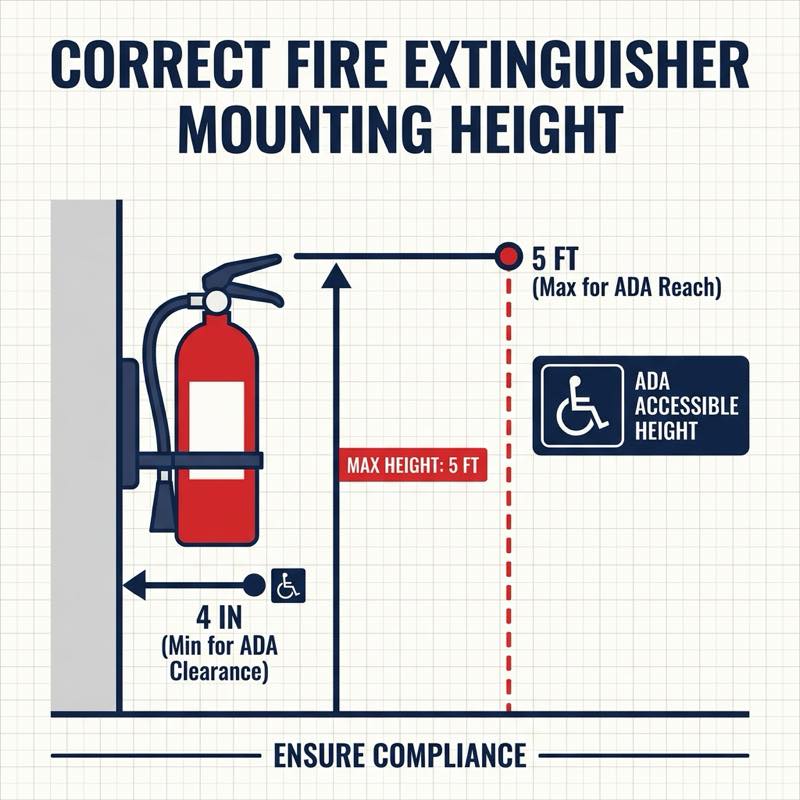
The height is measured from the floor to the carrying handle (or the top of the unit if there is no separate handle). This matters because the carrying handle is what you grab in an emergency - if it's out of reach, the extinguisher is effectively useless.
Most standard commercial ABC fire extinguishers weigh between 5 and 30 pounds, so the 5-foot maximum applies. A typical 10-pound ABC unit is about 20 inches tall, which means the bottom of the bracket should be installed at approximately 40 inches from the floor to keep the top at the 60-inch limit.
Why the 4-Inch Minimum Clearance Matters
The 4-inch minimum clearance from the floor serves three important purposes:
- Moisture protection - Floor-level moisture from mopping, spills, or flooding can corrode the cylinder bottom and cause the unit to fail
- Visibility - An extinguisher sitting on the floor is harder to spot in an emergency and more likely to be blocked by stored items, trash, or furniture
- Cleaning access - The 4-inch gap allows janitorial staff to sweep and mop underneath without moving the extinguisher
FDNY Will Cite Floor-Mounted Extinguishers
In New York City, FDNY inspectors specifically check for proper mounting height. An extinguisher sitting on the floor or on a shelf below the 4-inch mark is an immediate violation, even if the unit itself is fully charged and current on inspection. Each violation carries a fine starting at $1,000.
Mounting Brackets vs. Cabinets
There are two primary ways to mount a fire extinguisher: brackets and cabinets. Each has advantages depending on your building type and local code requirements:
Wall Brackets
Wall brackets are the most common mounting method. They secure the extinguisher with a strap or hook and allow quick removal in an emergency. Brackets are suitable for most commercial settings including offices, retail stores, warehouses, and residential buildings.
- Most affordable option ($10-$30 per bracket)
- Quick access - no cabinet door to open
- Visible from a distance, easy to locate
- Requires solid wall mounting into studs or with proper anchors
Fire Extinguisher Cabinets
Cabinets enclose the extinguisher behind a glass or breakaway panel. They're required in certain occupancies by local building codes, particularly in NYC buildings:
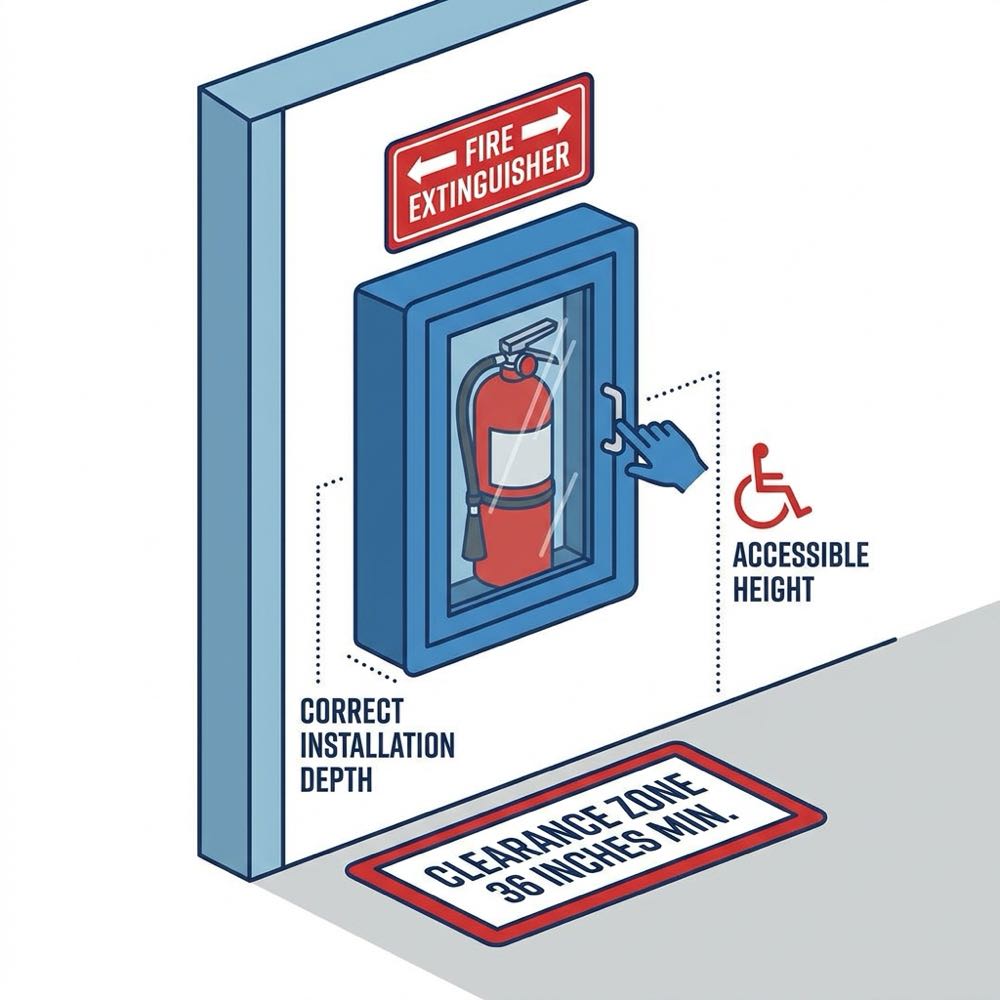
- Required in hospitals, schools, high-rise buildings, and public assemblies in many jurisdictions
- Protects extinguisher from damage, tampering, and environmental exposure
- Must have clear signage identifying the extinguisher type
- Cabinets cannot be locked unless they have an approved breakaway device
- Recessed cabinets must not reduce the fire rating of the wall
Recessed vs. Surface-Mount Cabinets
Recessed cabinets sit inside the wall cavity and don't protrude into walkways - preferred in hallways and corridors. Surface-mount cabinets attach to the wall surface and are easier to install but may obstruct narrow passages. In NYC, A&J Fire installs both types and can advise which one your building code requires.
ADA and Accessibility Considerations
The Americans with Disabilities Act (ADA) adds another layer to fire extinguisher placement. If a fire extinguisher projects more than 4 inches from the wall into a walkway, it becomes a protruding object under ADA standards. This matters in hallways and circulation paths:
- Protruding objects between 27 and 80 inches from the floor must not extend more than 4 inches from the wall if they're in a circulation path
- Recessed cabinets solve this problem by keeping the extinguisher flush with the wall surface
- Surface-mounted units in hallways may need alcoves or recessed placement to meet ADA requirements
- Reach range - ADA recommends that operable parts be between 15 and 48 inches from the floor for forward approach, and between 15 and 54 inches for side approach
For most standard ABC extinguishers, mounting the carrying handle at 48 inches satisfies both NFPA 10 (under 5 feet) and ADA reach requirements. This is the sweet spot that A&J Fire recommends for maximum accessibility.
Fire Extinguisher Placement Rules Beyond Height
Mounting height is just one part of proper placement. NFPA 10 and the FDNY also require:
- Travel distance - Extinguishers must be within 75 feet of travel distance for Class A hazards and within 50 feet for Class B hazards
- Visibility - Extinguishers must be visible or clearly marked with signage if placement is not obvious
- Unobstructed access - Nothing can block the path to an extinguisher, including furniture, stored items, or decorations
- Near exits - In most cases, extinguishers should be placed near exits so users can evacuate if the fire is too large
- Correct type for hazard - The extinguisher class must match the hazard in the area (ABC for general areas, Class K for kitchens, etc.)
Professional Fire Extinguisher Installation from A&J Fire
For building owners and facility managers in the New York City metro area, A&J Fire Extinguisher provides complete installation services:
- Code-compliant installation - Every mount meets NFPA 10 height requirements and FDNY standards
- Bracket and cabinet installation - We install wall brackets, surface-mount cabinets, and recessed cabinets
- Same-day service available - Get your extinguishers properly mounted and tagged in one visit
- All 5 boroughs, Long Island, and NJ - Full NYC metro coverage from our Brooklyn headquarters
- FDNY violation correction - If you've been cited for improper mounting, we fix it fast
Don't risk an FDNY violation for improper mounting. Schedule professional installation or call us directly.
Our team at A&J Fire provides fire extinguisher installation, FDNY-certified inspections, and cabinet installation across all five NYC boroughs. Check our inspection cost guide for pricing details. Call (718) 852-2762 to schedule service. The most common unit to mount is an ABC fire extinguisher, which covers most household and commercial fire hazards. Mounting rules differ for vehicles - our car fire extinguisher guide covers automotive mounting options.
Frequently Asked Questions
According to NFPA 10, fire extinguishers weighing 40 pounds or less should be mounted with the top of the unit no higher than 5 feet (60 inches) from the floor. Extinguishers heavier than 40 pounds should be mounted with the top no higher than 3.5 feet (42 inches) from the floor. The bottom of all fire extinguishers must be at least 4 inches above the floor. Most standard ABC dry chemical extinguishers weigh between 5 and 30 pounds, so the 5-foot rule applies.
NFPA 10 Section 6.1.3 specifies that portable fire extinguishers shall be installed using mounting brackets or cabinets. For extinguishers 40 lbs or less, the carrying handle should be no more than 5 feet from the floor. For extinguishers over 40 lbs, the carrying handle should be no more than 3.5 feet from the floor. The bottom of the extinguisher must be at least 4 inches above the floor to prevent moisture damage and allow cleaning underneath.
Yes. NFPA 10 requires the bottom of every fire extinguisher to be at least 4 inches above the floor. Mounting an extinguisher directly on the floor or within 4 inches of the floor violates NFPA requirements and FDNY fire code. Low-mounted extinguishers are harder to see, harder to grab in an emergency, and more susceptible to water damage, corrosion, and obstruction from stored items.
Fire extinguishers are not required to be in cabinets by NFPA 10, but many local codes - including NYC Building Code - require cabinets for extinguishers in certain occupancies like hospitals, schools, and high-rise buildings. Cabinets protect the extinguisher from damage, tampering, and environmental exposure. If a cabinet is used, it must have clear signage and cannot be locked unless it has an approved breakaway device.
An improperly mounted fire extinguisher violates NFPA 10 and local fire codes. In New York City, FDNY inspectors will cite this as a violation with fines starting at $1,000 per unit. More importantly, a wrongly mounted extinguisher may be difficult to reach in an emergency. If it's too high, someone with limited mobility may not be able to access it. If it's too low, it could be blocked by furniture or damaged by floor-level moisture.
Need Fire Extinguisher Installation?
Code-compliant mounting, FDNY-certified service, same-day installation - serving Brooklyn, Queens, Manhattan, Bronx, Staten Island, Long Island & New Jersey since 1965.
(718) 852-2762