🔑 Key Takeaways
- NFPA 1192 requires at least one 1A:10BC rated fire extinguisher in every RV
- Most RV owners should choose ABC rated extinguishers for comprehensive protection against fuel, propane, electrical, and fabric fires
- Mount your extinguisher within 24 inches of the primary exit, bottom at least 4 inches off the floor
- Inspect monthly - check pressure gauge, safety pin, and for damage or corrosion
- Replace extinguishers older than 12 years without professional servicing
Our team at A&J Fire provides fire extinguisher inspections, recharge services, and fire safety equipment across all five NYC boroughs. Call (718) 852-2762 to schedule service.
Whether you're rolling through Brooklyn in a camper van or parking your Class A motorhome at a national park, fire safety is not optional - it's required by law. The fire extinguisher for RV requirements are set by NFPA 1192, the national standard for recreational vehicle fire protection, and every RV on the road must comply.
RV fires are more common and more dangerous than most owners realize. Between propane appliances, 12V and 120V electrical systems, engine compartments, and cramped quarters filled with fabric and wood, your RV combines almost every major fire risk into one mobile package. Without the right extinguisher - properly mounted and regularly inspected - a small fire can become a total loss in under two minutes.
This guide breaks down exactly what kind of extinguisher your RV needs, where to mount it, how to inspect it, and what the law requires - whether you own a travel trailer, fifth wheel, camper, or motorhome.
NFPA 1192 Requirements: What the Law Says
The NFPA 1192 standard (Standard on Recreational Vehicles) mandates fire protection equipment for all recreational vehicles. Under this code:
- All RVs must carry at least one portable fire extinguisher with a minimum rating of 1A:10BC
- The extinguisher must be readily accessible - not stored in locked compartments or behind equipment
- It must be mounted within 24 inches of the primary exit door
- The bottom of the extinguisher must be at least 4 inches off the floor
- The extinguisher must bear a listing label from a recognized testing laboratory (UL, ULC, or equivalent)
📋 What Does 1A:10BC Mean?
The "1A" means the extinguisher can handle the equivalent of 1.25 gallons of water on a Class A fire (ordinary combustibles like wood, paper, fabric). The "10B" means it can cover 10 square feet of a Class B fire (flammable liquids like gasoline, propane). The "C" indicates it's safe to use on live electrical equipment. A standard 5-pound ABC dry chemical extinguisher typically exceeds this minimum rating.
While NFPA 1192 sets the minimum, fire safety professionals recommend carrying at least two extinguishers - one near the exit and one in the kitchen or sleeping area. For motorhomes with engine compartments, a third unit accessible from outside is a smart addition.
Class BC vs ABC: Which Extinguisher Does Your RV Need?
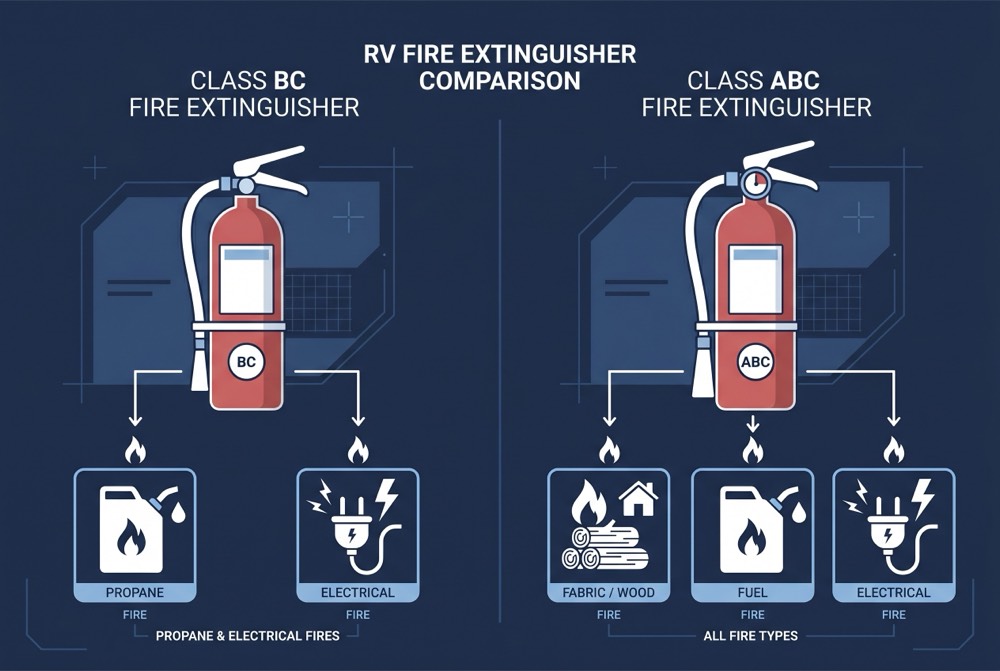
RV owners often ask whether a Class BC or ABC extinguisher is the right choice. The answer depends on what types of fires your RV is most likely to experience - and the answer is "all of them."
| Fire Type | Class BC Covers | Class ABC Covers | Common in RVs? |
|---|---|---|---|
| Class A (wood, fabric, paper) | ❌ No | ✅ Yes | ✅ Bedding, curtains, cabinetry |
| Class B (gasoline, propane, oil) | ✅ Yes | ✅ Yes | ✅ Propane tanks, fuel systems |
| Class C (electrical) | ✅ Yes | ✅ Yes | ✅ 12V/120V wiring, appliances |
Here's the bottom line: your RV interior is filled with Class A materials - mattresses, blankets, curtains, cabinets, wall coverings, and paper products. A BC extinguisher won't put out a mattress fire or curtain fire. An ABC extinguisher handles all three classes, and the weight difference is negligible.
⚠️ Important: Dry Chemical vs Clean Agent
Most ABC extinguishers use dry chemical (ammonium phosphate) powder. It's effective but makes a mess and can corrode electronics in an enclosed RV space. Consider a clean agent extinguisher (Halotron or FE-36) for electronics protection if your budget allows - they leave no residue and are safe for sensitive equipment. However, clean agents typically don't carry an "A" rating, so you'd still want a small ABC unit for general coverage.
Where to Mount Your RV Fire Extinguisher
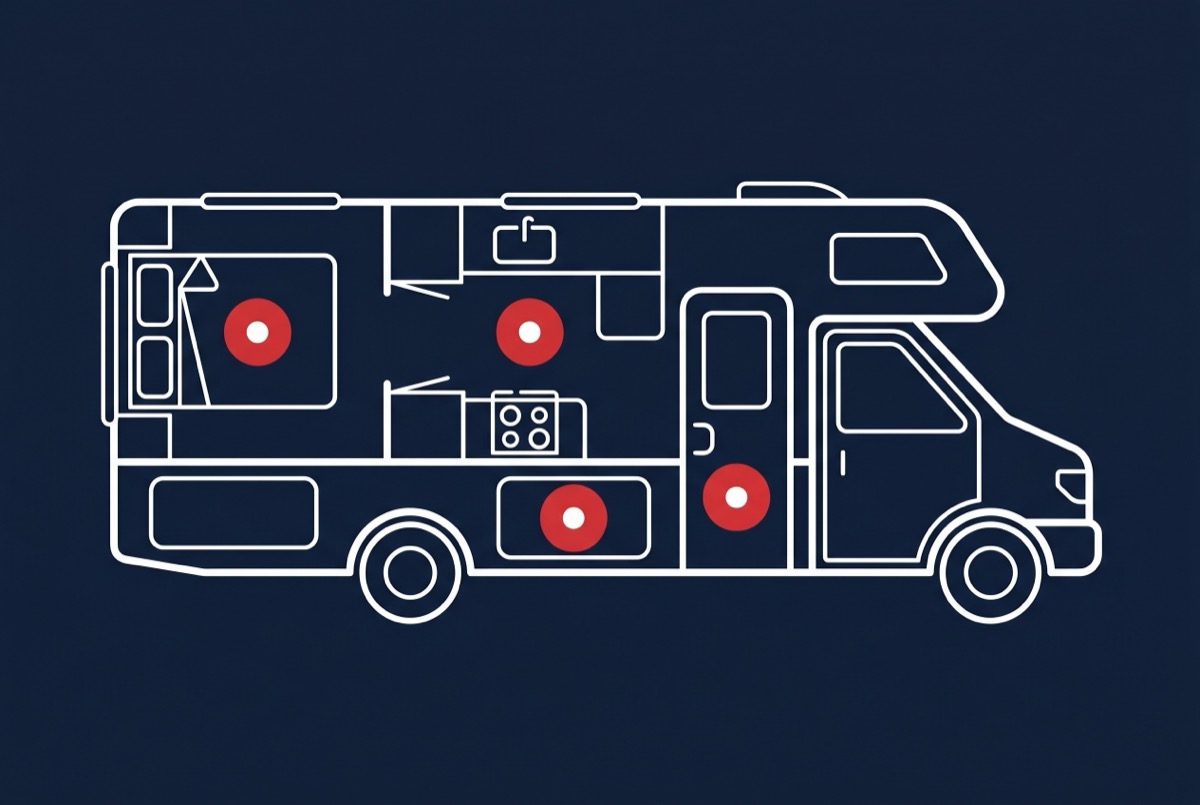
Placement matters as much as having the right extinguisher. NFPA 1192 requires mounting within 24 inches of the primary exit, but smart RV owners go further:
Recommended Mounting Locations
- Near the exit door - The legal minimum. If a fire breaks out, you grab the extinguisher on your way in or out. Use a quick-release bracket - NOT a zip tie or loose shelf.
- Kitchen/galley area - Cooking fires are the most common RV fire, and you need to reach the extinguisher within seconds.
- Sleeping area - Nighttime fires are the most dangerous. An extinguisher within arm's reach of the bed can save lives.
- Outside storage compartment - For exterior fires (tire, brake, or engine), you need an extinguisher accessible from outside the RV without entering the vehicle.
🔧 Quick-Release Brackets Are Essential
Don't just set the extinguisher on a shelf. Use a vehicle-mounted quick-release bracket designed for RVs. In an emergency, you should be able to grab the extinguisher in under 3 seconds. Brackets that require unscrewing or unlatching are not acceptable - use push-to-mount or strap-style quick-release brackets.
RV-Specific Fire Risks You Need to Know
RVs face a unique combination of fire hazards that make carrying the right extinguisher critical:
- Propane systems - Stove, furnace, water heater, and refrigerator all run on propane. Leaks in the lines, regulator failures, or improper connections can cause explosive fires. Propane fires are Class B and require a BC or ABC rated extinguisher.
- 12V and 120V electrical systems - RVs have complex electrical systems. Loose connections, overloaded circuits, corroded terminals, and aging wiring cause Class C electrical fires. Shore power pedestals at campgrounds can also deliver surges.
- Engine compartment fires - Motorhomes have engine bays with fuel lines, belts, and hot exhaust components. A fluid leak onto a hot manifold can ignite in seconds.
- Kitchen/galley cooking fires - Grease fires from cooking are Class B (or Class K if cooking oil is involved). Never use water on a grease fire - use your ABC or BC extinguisher.
- Tire and brake fires - Overheated bearings, locked brakes, or blowouts can ignite tires. These burn hot and produce toxic smoke. An outside-accessible extinguisher is essential.
According to the RVIA (Recreation Vehicle Industry Association), propane and electrical failures account for over 60% of all RV fires. That's why carrying at minimum an ABC rated extinguisher - not just BC - is so important.
Monthly Inspection Checklist
Having the right extinguisher means nothing if it doesn't work when you need it. Follow this monthly checklist:
- Pressure gauge in the green zone - If the needle is outside the green section, the extinguisher needs recharging or replacement
- Safety pin and tamper seal intact - If the pin is missing or the seal is broken, the extinguisher may have been used or tampered with
- No visible damage - Check for dents, rust, corrosion, or cracks in the handle or nozzle
- Shake dry chemical extinguishers - The powder can compact at the bottom over time, making the extinguisher ineffective. Give it a firm shake once a month to keep the agent loose
- Mounting bracket secure - Ensure the bracket is still firmly attached to the wall and the extinguisher clicks into place
⚠️ Replacement Timeline
Replace any dry chemical extinguisher that is older than 12 years from the manufacture date - even if it has never been used. The chemical agent degrades over time. For professional servicing, A&J Fire Extinguisher provides annual inspections, recharging, and hydrostatic testing throughout NYC, Long Island, and New Jersey.
RV Fire Extinguisher Requirements by Vehicle Type
| RV Type | Minimum Required | Recommended | Key Risks |
|---|---|---|---|
| Travel Trailer | 1× 1A:10BC | 1× ABC (5 lb) + 1× kitchen | Propane, cooking, electrical |
| Fifth Wheel | 1× 1A:10BC | 2× ABC (5 lb each) | Propane, larger kitchen, more outlets |
| Camper Van | 1× 1A:10BC | 1× ABC (5 lb) | Propane, compact space, 12V |
| Class B Motorhome | 1× 1A:10BC | 1× ABC (5 lb) + 1× outside | Engine, propane, electrical |
| Class C Motorhome | 1× 1A:10BC | 2× ABC (5 lb) + 1× outside | Engine, dual fuel, generator |
| Class A Motorhome | 1× 1A:10BC | 2× ABC (5 lb) + 1× kitchen + 1× outside | Large engine bay, multiple propane, generator |
Professional RV Fire Extinguisher Services from A&J Fire
For RV owners in the New York City metro area, Long Island, and New Jersey, A&J Fire Extinguisher provides complete fire safety services:
- Professional inspections - FDNY-certified annual inspections that satisfy NFPA 1192 requirements and local fire codes
- Recharging and hydrostatic testing - Full servicing for used, expired, or aging extinguishers
- Proper mounting bracket installation - We install quick-release brackets in the correct locations for NFPA compliance
- Extinguisher sales - We carry ABC, BC, and clean agent units rated for RV use
- Annual inspection programs - Scheduled maintenance so your fire extinguisher for your RV is always ready
Whether you're a full-time RVer, weekend warrior, or seasonal camper, don't wait for a fire to find out your extinguisher doesn't work. Schedule a professional inspection or call us directly - we've been protecting New Yorkers since 1965.
Our team at A&J Fire provides fire extinguisher inspections, recharge services, and fire safety equipment across all five NYC boroughs. We also offer marine fire extinguisher services for boaters. Call (718) 852-2762 to schedule service. For a smaller vehicle, our guide to car fire extinguishers covers the essentials for everyday driving. An ABC fire extinguisher is the most versatile option for RVs, covering combustible, fuel, and electrical fires.
Frequently Asked Questions
NFPA 1192 requires all RVs to carry at least one 1A:10BC rated fire extinguisher. The BC rating covers fuel, propane, and electrical fires - the most common RV fire types. Most RV owners and safety experts recommend an ABC rated extinguisher because it also covers Class A fires involving fabric, bedding, curtains, and wood - materials found throughout every RV interior. A 5-pound ABC extinguisher provides the best balance of coverage and accessibility.
NFPA 1192 requires the fire extinguisher to be mounted within 24 inches of the primary exit door, with the bottom of the extinguisher at least 4 inches off the floor. Safety experts recommend additional extinguishers near the kitchen/galley area, in the sleeping area, and in an outside storage compartment for exterior access. Always use a quick-release bracket so you can grab the extinguisher in under 3 seconds.
Check your RV fire extinguisher monthly: verify the pressure gauge is in the green zone, confirm the safety pin and tamper seal are intact, and look for visible damage, dents, or corrosion. Shake dry chemical extinguishers monthly to prevent the agent from compacting. Replace any extinguisher that shows low pressure, damage, or is older than 12 years without professional servicing. A professional inspection should be performed annually by a certified fire safety company.
The most common RV fire causes are: 1) Propane system leaks from stoves, furnaces, and water heaters, 2) Electrical shorts from 12V and 120V wiring, especially in older rigs, 3) Engine and transmission fires in motorhomes, 4) Kitchen cooking fires in the galley, and 5) Tire and brake fires from overheated bearings or locked brakes. Propane and electrical failures account for over 60% of all RV fires.
An ABC fire extinguisher is better for most RVs. While a BC rated extinguisher satisfies the NFPA 1192 minimum and covers fuel and electrical fires, an ABC extinguisher also covers Class A fires involving the fabrics, bedding, curtains, and wood found throughout every RV interior. The small weight difference is worth the significantly broader protection. A 5-pound ABC unit is the most popular choice for RV owners.
Need Your RV Fire Extinguisher Inspected?
FDNY-certified inspections, recharging, and mounting bracket installation - serving Brooklyn, Queens, Manhattan, Bronx, Staten Island, Long Island & New Jersey since 1965.
📞 (718) 852-2762